


Page 40 - Dental Practice August 2022
P. 40
40-41-Melissa article-Q8:18-22-Lanka Mahesh.qxd  8/17/2022  6:34 PM  Page 1


             restorative dentistry section


                  MITIGATING SECONDARY CARIES


                                                        MELISSA JOHNSON


             INTRODUCTION
             G.V. Black’s class I caries pathology is classified as simple (1 surface)
             lesions that affect either the occlusal, buccal, or lingual aspects of
             teeth. With only a single surface involved, the clinician may dispense
             with  the  additional  armamentarium  needed  to  treat  compound
             (2 surfaces) or even complex (3 surface) caries. With the advent of
             direct, adhesively-bonded composite resin, contemporary dentists
             are able to deliver both minimally invasive and aesthetic results to
             patients when restoring class I decay. Various intrinsic and extrinsic
             factors including preparation designs,  extension of  pathologicala-
             gents, patient’s overall caries risk, and the clinician’s ability to con-
             trol  moisture  all  add  to  the  complexity  and  long-term  success  of
             these otherwise straight forward composite restorations.
               This case report begins with an evaluation of a re-care patient: a
             healthy twenty six-year-old male presented for his routine cleaning
             and  exam.  The  exam  revealed  occlusal  caries  on  six  of  his  eight
             molars, making him a high caries risk patient. Estimated sizes of the
             lesions, age, salivary flow, oral hygiene and the use of a high strength
             fluoride treatment were weighed and used as discussion points to
             assist the patient and clinician in deciding on the best treatment out-  FIG 1
             comes. After reviewing all parameters, it was decided that conserva-
             tive composite restorations would be in the patient’s best interest.
               With  no  pain  or  sensitivity  being  reported  by  the  patient,  the
             rational  starting  point  was  to  treat  the  deepest  decay  first,  teeth
             numbers 18, 19 (international system: 36, 37). Teeth numbers 18
             and 19 were pulp tested and responded normally to percussion and
             cold testing. In an effort to mitigate risk factors and create a sound,
             pain free restoration the following steps were taken:
               Rubber  Dam  isolation  to  combat  intraoral  humidity  and  the
             pooling of saliva at the back of the mouth, biomimetic technique-
             sused in an effort to reduce stresses created by the high configura-
             tion factor of the preparation, and finally, a high-quality polishing
             technique to ensure minimal plaque retention and reduce risk of  FIG 2  FIG 3           FIG 4
             recurrent decay at the enamel composite margins.
                                                                    dried.
             PROCEDURE                                            6. Two layers of a universal adhesive [Zipbond, SDI Limited] were
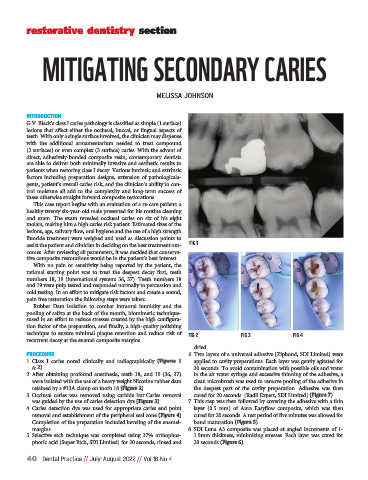
             1. Class  I  caries  noted  clinically  and  radiographically  (Figures  1   applied to cavity preparations. Each layer was gently agitated for
              & 2).                                                 30 seconds. To avoid contamination with possible oils and water
             2. After  obtaining  profound  anesthesia,  teeth  18,  and  19  (36,  37)  in the air water syringe and excessive thinning of the adhesive, a
              were isolated with the use of a heavy weight Nicotine rubber dam  clean microbrush was used to remove pooling of the adhesive in
              retained by a #13A clamp on tooth 18 (Figure 2).      the  deepest  part  of  the  cavity  preparation.  Adhesive  was  then
             3. Occlusal  caries  was  removed  using  carbide  bur.Caries  removal  cured for 20 seconds. [Radii Expert, SDI Limited] (Figure 7).
              was guided by the use of caries detection dye (Figure 3).  7. This step was then followed by covering the adhesive with a thin
             4. Caries detection dye was used for appropriate caries end point  layer  (0.5  mm)  of  Aura  Easyflow  composite,  which  was  then
              removal and establishment of the peripheral seal zone (Figure 4)  cured for 20 seconds. A rest period of five minutes was allowed for
              Completion of the preparation included beveling of the enamel-  bond maturation (Figure 5).
              margins.                                            8. SDI Luna A3 composite was placed at angled increments of 1-
             5. Selective  etch  technique  was  completed  using  37%  orthophos-  1.5mm thickness, minimizing stresses. Each layer was cured for
              phoric acid [Super Etch, SDI Limited] for 20 seconds, rinsed and  20 seconds (Figure 6).

             40   Dental Practice // July-August 2022 // Vol 18 No 4

