


Page 57 - Dental Practice August 2022
P. 57
54-58-Gaurav article-Q8:18-22-Lanka Mahesh.qxd  8/17/2022  6:43 PM  Page 4


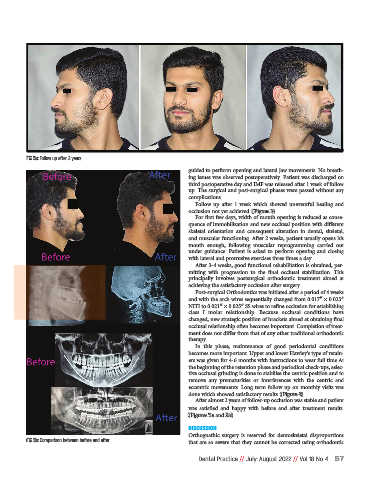
             FIG 5a: Follow up after 2 years

                                                                  guided to perform opening and lateral jaw movements. No breath-
                                                                  ing issues was observed postoperatively. Patient was discharged on
                                                                  third postoperative day and IMF was released after 1 week of follow
                                                                  up. The surgical and post-surgical phases were passed without any
                                                                  complications.
                                                                    Follow  up  after  1  week  which  showed  uneventful  healing  and
                                                                  occlusion not yet achieved. (Figure 3)
                                                                    For first few days, width of mouth opening is reduced as conse-
                                                                  quence of immobilization and new occlusal position with different
                                                                  skeletal  orientation  and  consequent  alteration  in  dental,  skeletal,
                                                                  and muscular functioning. After 2 weeks, patient usually opens his
                                                                  mouth  enough,  following  muscular  reprogramming  carried  out
                                                                  under  guidance.  Patient  is  asked  to  perform  opening  and  closing
                                                                  with lateral and protrusive exercises three times a day.
                                                                    After 3-4 weeks, good functional rehabilitation is obtained, per-
                                                                  mitting  with  progression  to  the  final  occlusal  stabilization.  This
                                                                  principally  involves  postsurgical  orthodontic  treatment  aimed  at
                                                                  achieving the satisfactory occlusion after surgery.
                                                                    Post-surgical Orthodontics was initiated after a period of 4 weeks
                                                                  and with the arch wires sequentially changed from 0.017” × 0.025″
                                                                  NITI to 0.021″ × 0.025″ SS wires to refine occlusion for establishing
                                                                  class  I  molar  relationship.  Because  occlusal  conditions  have
                                                                  changed, new strategic position of brackets aimed at obtaining final
                                                                  occlusal relationship often becomes important. Completion of treat-
                                                                  ment does not differ from that of any other traditional orthodontic
                                                                  therapy.
                                                                    In  this  phase,  maintenance  of  good  periodontal  conditions
                                                                  becomes more important. Upper and lower Hawley's type of retain-
                                                                  ers was given for 4-6 months with instructions to wear full time.At
                                                                  the beginning of the retention phase and periodical check-ups, selec-
                                                                  tive occlusal grinding is done to stabilise the centric position and to
                                                                  remove  any  prematurities  or  interferences  with  the  centric  and
                                                                  eccentric movements. Long term follow up on monthly visits was
                                                                  done which showed satisfactory results. (Figure 4)
                                                                    After almost 2 years of follow-up occlusion was stable and patient
                                                                  was  satisfied  and  happy  with  before  and  after  treatment  results.
                                                                  (Figures 5a and 5b)

                                                                  DISCUSSION
                                                                  Orthognathic  surgery  is  reserved  for  dentoskeletal  disproportions
             FIG 5b: Comparison between before and after          that are so severe that they cannot be corrected using orthodontic

                                                                      Dental Practice // July-August 2022 // Vol 18 No 4 57

