


Page 70 - Dental Practice South Asia 18-6
P. 70
teeth whitening


              THE LATEST INNOVATION IN PEROXIDE FREE - OTC TEETH WHITENING REGIMEN


                                                        DR.SHIPRA JAISWAL

             INTRODUCTION
             Currently, the widely used tooth-whitening methods can be gener-
             ally divided into two parts, the invasive whitening methods and the
             non-invasive whitening methods. Due to the teeth being irreversibly
             damaged by cutting and grinding the enamels when using the inva-
             sive whitening technology with brighter Veneers /Crowns , the non-
             invasive methods using active whitening ingredients in the form of
             gels/pastes have gained more and more attentions.
                There  are  many  non-invasive  ingredients  such  as  Hydrogen
             Peroxide (HP) and Carbamide Peroxide (CP). Different HP and CP
             based  gels  are  used  currently  for  at  Home  and  In-Office  dental
             bleaching according to Jurisdictional Regulations. However, whiten-
             ing of teeth by Peroxide based ingredients may be harmful to the
             health of oral mucosa and Enamel/Dentin if gone wrong.
                In search of bleaching agents that may be alternatives to HP or
             CP, there has been a recent interest in Organic Peroxides such as
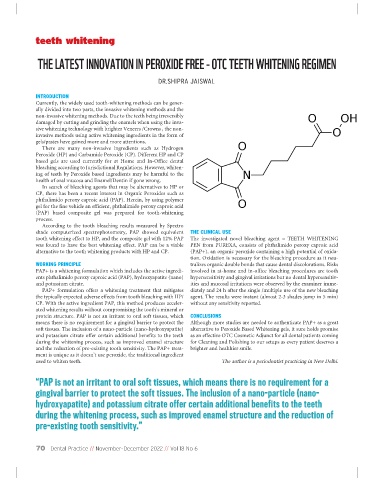
             phthalimido peroxy caproic acid (PAP). Herein, by using polymer
             gel for the fine vehicle an efficient, phthalimido peroxy caproic acid
             (PAP)  based  composite  gel  was  prepared  for  tooth-whitening
             process.
                According  to  the  tooth  bleaching  results  measured  by  Spectro
             shade  computerized  spectrophotometry,  PAP  showed  equivalent  THE CLINICAL USE
             tooth whitening effect to HP, and the composite gel with 12% PAP  The  investigated  novel  bleaching  agent  –  TEETH  WHITENING
             was found to have the best whitening effect. PAP can be a viable  PEN from PUREXA, consists of phthalimido peroxy caproic acid
             alternative to the tooth whitening products with HP and CP.  (PAP+), an organic peroxide containing a high potential of oxida-
                                                                   tion. Oxidation is necessary for the bleaching procedure as it neu-
             WORKING PRINCIPLE                                     tralizes organic double bonds that cause dental discolorations. Risks
             PAP+ is a whitening formulation which includes the active ingredi-  involved in at-home and in-office bleaching procedures are tooth
             ents phthalimido peroxy caproic acid (PAP), hydroxyapatite (nano)  hypersensitivity and gingival irritations but no dental hypersensitiv-
             and potassium citrate.                                ities and mucosal irritations were observed by the examiner imme-
                PAP+  formulation  offers  a  whitening  treatment  that  mitigates  diately and 24 h after the single /multiple use of the new bleaching
             the typically expected adverse effects from tooth bleaching with HP/  agent. The results were instant (almost 2-3 shades jump in 5 min)
             CP. With the active ingredient PAP, this method produces acceler-  without any sensitivity reported.
             ated whitening results without compromising the tooth’s mineral or
             protein structure. PAP is not an irritant to oral soft tissues, which  CONCLUSIONS
             means there is no requirement for a gingival barrier to protect the  Although more studies are needed to authenticate PAP+ as a great
             soft tissues. The inclusion of a nano-particle (nano-hydroxyapatite)  alternative to Peroxide Based Whitening gels, it sure holds promise
             and potassium citrate offer certain additional benefits to the teeth  as an effective OTC Cosmetic Adjunct for all dental patients coming
             during the whitening process, such as improved enamel structure  for Cleaning and Polishing to our setups as every patient deserves a
             and the reduction of pre-existing tooth sensitivity. The PAP+ treat-  brighter and healthier smile.
             ment is unique as it doesn’t use peroxide, the traditional ingredient
             used to whiten teeth.                                            The author is a periodontist practicing in New Delhi.


             “PAP is not an irritant to oral soft tissues, which means there is no requirement for a

             gingival barrier to protect the soft tissues. The inclusion of a nano-particle (nano-
             hydroxyapatite) and potassium citrate offer certain additional benefits to the teeth
             during the whitening process, such as improved enamel structure and the reduction of

             pre-existing tooth sensitivity.”


              70   Dental Practice // November-December 2022 // Vol 18 No 6

