


Page 26 - Dental Practice August 2022
P. 26
26-30-Richard-Q8:18-22-Lanka Mahesh.qxd  8/17/2022  6:13 PM  Page 1


             implantology section


                             COMPLEX PROBLEMS SOLVED


                                WITH BIOLOGICAL MINDSET


                                                         RICHARD WINTER

             This  is  a  case  study  of  how  an  implant  centered  treatment  plan
             resulted in a non- surgical solution for a patient with pain, missing
             teeth, and severely mal-posed dentition with mobility.

             DYNAMIC TREATMENT SOLUTIONS
             Dentists are specialists in diagnosing and treating problems of the
             stomatognathic system. Typically, weare presented with problems
             that can be defined as a subset of an anatomic issue such as a tooth
             ache  resulting  from  pulpitis  or  a  cracked  tooth.  This  problem-
             focused diagnosis is the “bread and butter” of general dental prac-
             tice. When examining a patient, we are taught to examine for oral-
             cancer, occlusal problems, periodontal or endodontic issues, caries,
             etc.  but  when  multi-factorial  problems  exist,  we  must  creatively
             present plans that will address disease processes while honouring a
             patient’s chief complaints, concerns and financial limits.
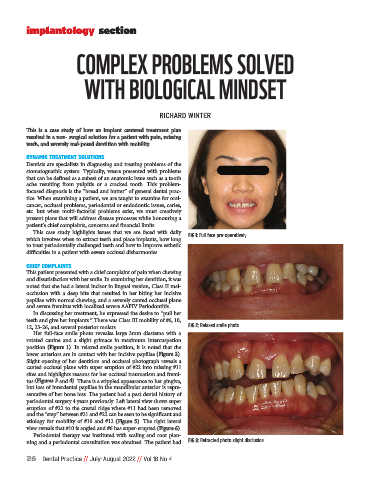
               This  case  study  highlights  issues  that  we  are  faced  with  daily  FIG 1: Full face pre-operatively
             which involves when to extract teeth and place implants, how long
             to treat periodontally challenged teeth and how to improve esthetic
             difficulties in a patient with severe occlusal disharmonies.
             CHIEF COMPLAINTS
             This patient presented with a chief complaint of pain when chewing
             and dissatisfaction with her smile. In examining her dentition, it was
             noted that she had a lateral incisor in lingual version, Class II mal-
             occlusion with a deep bite that resulted in her biting her incisive
             papillae with normal chewing, and a severely canted occlusal plane
             and severe fremitus with localized severe AAPIV Periodontitis.
               In discussing her treatment, he expressed the desire to “pull her
             teeth and give her implants.” There was Class III mobility of #6, 10,
             12, 23-26, and several posterior molars.             FIG 2: Relaxed smile photo
               Her  full-face  smile  photo  revealsa  large  3mm  diastema  with  a
             rotated  canine  and  a  slight  grimace  in  maximum  intercuspation
             position (Figure 1). In relaxed smile position, it is noted that the
             lower anteriors are in contact with her incisive papillae (Figure 2).
             Slight opening of her dentition and occlusal photograph reveals a
             canted occlusal plane with super eruption of #22 into missing #11
             sites and highlights reasons for her occlusal traumatism and fremi-
             tus (Figures 3 and 4). There is a stippled appearance to her gingiva,
             but loss of interdental papillae in the mandibular anterior is repre-
             sentative of her bone loss. The patient had a past dental history of
             periodontal surgery 4 years previously. Left lateral view shows super
             eruption of #22 to the crestal ridge where #11 had been removed
             and the “step” between #21 and #22 can be seen to be significant and
             etiology for mobility of #10 and #12  (Figure 5). The right lateral
             view reveals that #10 is angled and #6 has super-erupted (Figure 6).
               Periodontal therapy was instituted with scaling and root plan-
             ning and a periodontal consultation was obtained. The patient had  FIG 3: Retracted photo slight disclusion

             26   Dental Practice // July-August 2022 // Vol 18 No 4

