


Page 21 - Dental Practice August 2022
P. 21
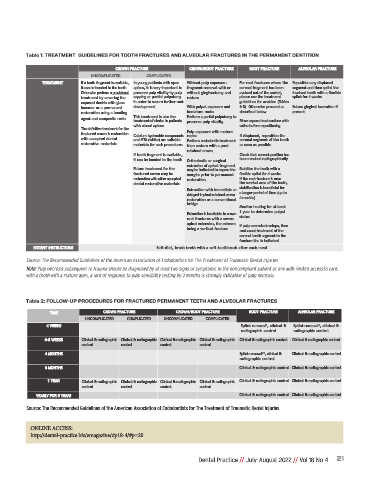
Table 2: TREATMENT GUIDELINES FOR TOOTH FRACTURES AND ALVEOLAR FRACTURES IN THE PERMANENT DENTITION

                                          CROWN FRACTURE           CROWN/ROOT FRACTURE  ROOT FRACTURE  ALVEOLAR FRACTURE
                                  UNCOMPLICATED     COMPLICATED
                  TREATMENT    If a tooth fragment is available,  In young patients with open   Without pulp exposure:   For root fractures where the  Reposition any displaced
                               it can be bonded to the tooth.   apices, it is very important to  fragment removal with or   coronal fragment has been   segment and then splint the
                               Otherwise perform a provisional   preserve pulp vitality by pulp   without gingivectomy and   avulsed out of the socket,   involved teeth with a flexible
                               treatment by covering the   capping or partial pulpotomy   restore.  please use the treatment   splint for 4 weeks.
                               exposed dentin with glass   in order to secure further root   guidelines for avulsion (Tables
                               ionomer or a permanent   development.  With pulpal exposure and   6-8). Otherwise proceed as   Suture gingival laceration if
                               restoration using a bonding        immature roots:  described below.  present.
                               agent and composite resin.  This treatment is also the   Perform a partial pulpotomy to
                                                treatment of choice in patients   preserve pulp vitality.  Rinse exposed root surface with
                                                with closed apices.                saline before repositioning.
                               The definitive treatment for the
                                                                  Pulp exposure with mature
                               fractured crown is restoration   Calcium hydroxide compounds  roots:  If displaced, reposition the
                               with accepted dental   and MTA (white) are suitable   Perform endodontic treatment  coronal segment of the tooth
                               restorative materials.  materials for such procedures. then restore with a post-   as soon as possible.
                                                                  retained crown.
                                                If tooth fragment is available,    Check that correct position has
                                                it can be bonded to the tooth. Orthodontic or surgical   been reached radiographically.
                                                                  extrusion of apical fragment
                                                Future treatment for the   may be indicated to expose the   Stabilize the tooth with a
                                                fractured crown may be   margins prior to permanent   flexible splint for 4 weeks.
                                                restoration with other accepted   restoration.  If the root fracture is near
                                                dental restorative materials.      the cervical area of the tooth,
                                                                  Extraction with immediate or   stabilization is beneficial for
                                                                  delayed implant-retained crown   a longer period of time (up to
                                                                  restoration or a conventional   4 months).
                                                                  bridge.
                                                                                   Monitor healing for at least
                                                                  Extraction is inevitable in crown   1 year to determine pulpal
                                                                  root fractures with a severe   status.
                                                                  apical extension, the extreme
                                                                  being a vertical fracture.  If pulp necrosis develops, then
                                                                                   root canal treatment of the
                                                                                   coronal tooth segment to the
                                                                                   fracture line is indicated.
               PATIENT INSTRUCTIONS                     Soft diet, brush teeth with a soft toothbrush after each meal.
             Source: The Recommended Guidelines of the American Association of Endodontists for The Treatment of Traumatic Dental Injuries
             Note: Pulp necrosis subsequent to trauma should be diagnosed by at least two signs or symptoms. In the noncompliant patient or one with limited access to care,
             with a tooth with a mature apex, a lack of response to pulp sensibility testing by 3 months is strongly indicative of pulp necrosis.


             Table 3: FOLLOW-UP PROCEDURES FOR FRACTURED PERMANENT TEETH AND ALVEOLAR FRACTURES
                    TIME              CROWN FRACTURE          CROWN/ROOT FRACTURE     ROOT FRACTURE    ALVEOLAR FRACTURE
                                UNCOMPLICATED  COMPLICATED  UNCOMPLICATED  COMPLICATED
                   4 WEEKS                                                          Splint removal*, clinical &   Splint removal*, clinical &
                                                                                    radiographic control  radiographic control
                   6-8 WEEKS   Clinical & radiographic  Clinical & radiographic  Clinical & radiographic  Clinical & radiographic  Clinical & radiographic control  Clinical & radiographic control
                               control      control      control      control
                   4 MONTHS                                                        Splint removal**, clinical &   Clinical & radiographic control
                                                                                   radiographic control
                   6 MONTHS                                                        Clinical & radiographic control  Clinical & radiographic control
                    1 YEAR     Clinical & radiographic  Clinical & radiographic  Clinical & radiographic  Clinical & radiographic  Clinical & radiographic control Clinical & radiographic control
                               control      control      control      control
                YEARLY FOR 5 YEARS                                                 Clinical & radiographic control Clinical & radiographic control
             Source: The Recommended Guidelines of the American Association of Endodontists for The Treatment of Traumatic Dental Injuries


              ONLINE ACCESS:
              http://dental-practice.biz/emagazine/dp18-4/#p=20


                                                                      Dental Practice // July-August 2022 // Vol 18 No 4  21

