


Page 48 - Dental Practice August 2022
P. 48
48-51-VITA article-Q8:18-22-Lanka Mahesh.qxd  8/17/2022  6:37 PM  Page 1


             prosthodontic section


                                      35 YEARS OF VITABLOCS


                 A SCIENTIFICALLY PROVEN SUCCESS STORY


             INTRODUCTION
             VITA  Zahnfabrik  developed  the  first  CAD/CAM  material  and
             manufactured it 35 years ago in cooperation with the inventors of
             the CEREC system – this was the birth of VITABLOCS and an inter-
             national  success  story.  Thanks  to  the  material  development,  the
             world's  first  CAD/CAM-supported  inlay  made  of  VITABLOCS
             could be used on a patient at the University of Zurich in 1985. Since
             1986, monochromatic feldspar ceramic blocks have been available
             on  the  market  from  VITA  Zahnfabrik  and  have  been  used
             throughout  the  world  in  CEREC  milling  units.  In  2007,  the
             polychromatic variants VITABLOCS TriLuxe forte with shade gra-
             dients from the neck to the incisal area were created, and in 2010,
             VITABLOCS  RealLife  with  a  three-dimensional,  curved  shade
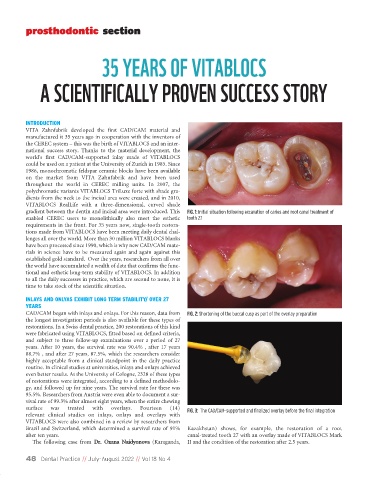
             gradient between the dentin and incisal area were introduced. This  FIG. 1: Initial situation following excavation of caries and root canal treatment of
             enabled  CEREC  users  to  monolithically  also  meet  the  esthetic  tooth 27
             requirements in the front. For 35 years now, single-tooth restora-
             tions made from VITABLOCS have been meeting daily dental chal-
             lenges all over the world. More than 30 million VITABLOCS blanks
             have been processed since 1990, which is why new CAD/CAM mate-
             rials in science  have to  be measured again and  again  against this
             established gold standard.  Over the years, researchers from all over
             the world have accumulated a wealth of data that confirms the func-
             tional and esthetic long-term stability of VITABLOCS. In addition
             to all the daily successes in practice, which are second to none, it is
             time to take stock of the scientific situation.
             INLAYS AND ONLYAS EXHIBIT LONG TERM STABILITY/ OVER 27
             YEARS
             CAD/CAM began with inlays and onlays. For this reason, data from  FIG. 2: Shortening of the buccal cusp as part of the overlay preparation
             the longest investigation periods is also available for these types of
             restorations. In a Swiss dental practice, 200 restorations of this kind
             were fabricated using VITABLOCS, fitted based on defined criteria,
             and  subject  to  three  follow-up  examinations  over  a  period  of  27
             years. After 10  years,  the survival  rate was 90.4%  ,  after  17  years
             88.7% , and after 27 years, 87.5%, which the researchers consider
             highly  acceptable  from  a  clinical  standpoint  in  the  daily  practice
             routine. In clinical studies at universities, inlays and onlays achieved
             even better results. At the University of Cologne, 2328 of these types
             of restorations were integrated, according to a defined methodolo-
             gy, and followed up for nine years. The survival rate for these was
             95.5%. Researchers from Austria were even able to document a sur-
             vival rate of 99.3% after almost eight years, when the entire chewing
             surface   was   treated   with   overlays.   Fourteen   (14)   FIG. 3:  The CAD/CAM-supported and finalized overlay before the final integration
             relevant  clinical  studies  on  inlays,  onlays  and  overlays  with
             VITABLOCS were also combined in a review by researchers from
             Brazil  and  Switzerland,  which  determined  a  survival  rate  of  91%  Kazakhstan)  shows,  for  example,  the  restoration  of  a  root
             after ten years.                                     canal-treated tooth 27 with an overlay made of VITABLOCS Mark
               The  following  case  from  Dr.  Oxana  Naidyonova (Karaganda,  II and the condition of the restoration after 2.5 years.

             48   Dental Practice // July-August 2022 // Vol 18 No 4

