


Page 22 - DP Vol 22 No 1
P. 22
AESTHETICS


                            SIMPLIFYING WORKFLOWS IN


                                 RESTORATIVE DENTISTRY


                            WITH INTUITIVE COMPOSITES


                                                          Sanah Sayed


           INTRODUCTION
           It is often said that simplicity is the ultimate sophistication however,
           when it comes to Restorative dentistry, reducing the armamentarium
           to deliver a highly aesthetic and optimally functional outcome is rarely
           a possibility – until now!
              The dynamic shift of global mindsets and demands have pushed
           research and development into a new phase of development. The
           need for simplicity in restorative dentistry is driven by the demand
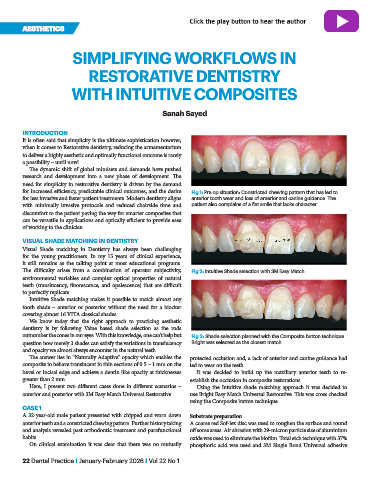
           for increased efficiency, predictable clinical outcomes, and the desire   Fig 1: Pre op situation: Constricted chewing pattern that has led to
           for less invasive and faster patient treatments. Modern dentistry aligns   anterior tooth wear and loss of anterior and canine guidance. The
           with minimally invasive protocols and reduced chairside time and   patient also complains of a flat smile that lacks character
           discomfort to the patient paving the way for smarter composites that
           can be versatile in applications and optically efficient to provide ease
           of working to the clinician.

           VISUAL SHADE MATCHING IN DENTISTRY
           Visual Shade matching in Dentistry has always been challenging
           for the young practitioners. In my 15 years of clinical experience,
           it still remains as the talking point at most educational programs.
           The difficulty arises from a combination of operator subjectivity,   Fig 2: Intuitive Shade selection with 3M Easy Match
           environmental variables and complex optical properties of natural
           teeth (translucency, fluorescence, and opalescence) that are difficult
           to perfectly replicate.
              Intuitive Shade matching makes it possible to match almost any
           tooth shade – anterior or posterior without the need for a blocker
           covering almost 16 VITA classical shades.
              We know today that the right approach to practicing aesthetic
           dentistry is by following Value based shade selection as the rods
           outnumber the cones in our eyes. With this knowledge, one can’t help but   Fig 3: Shade selection planned with the Composite button technique.
           question how merely 3 shades can satisfy the variations in translucency   Bright was selected as the closest match
           and opacity we almost always encounter in the natural teeth.
              The answer lies in “Naturally Adaptive” opacity which enables the   protected occlusion and, a lack of anterior and canine guidance had
           composite to behave translucent in thin sections of 0.5 – 1 mm on the   led to wear on the teeth.
           bevel or incisal edge and achieve a dentin like opacity at thicknesses   It was decided to build up the maxillary anterior teeth to re-
           greater than 2 mm.                                      establish the occlusion in composite restorations.
              Here, I present two different cases done in different scenarios –   Using the Intuitive shade matching approach it was decided to
           anterior and posterior with 3M Easy Match Universal Restorative.  use Bright Easy Match Universal Restorative. This was cross checked
                                                                   using the Composite button technique.
           CASE 1
           A 32-year-old male patient presented with chipped and worn down   Substrate preparation
           anterior teeth and a constricted chewing pattern. Further history taking   A coarse red Sof-lex disc was used to roughen the surface and round
           and analysis revealed past orthodontic treatment and parafunctional   off some areas. Air abrasion with 29-micron particle size of aluminium
           habits.                                                 oxide was used to eliminate the biofilm. Total etch technique with 37%
              On clinical examination it was clear that there was no mutually   phosphoric acid was used and 3M Single Bond Universal adhesive

           22 Dental Practice I January-February 2026 I Vol 22 No 1

