


Page 23 - DP Vol 22 No 1
P. 23
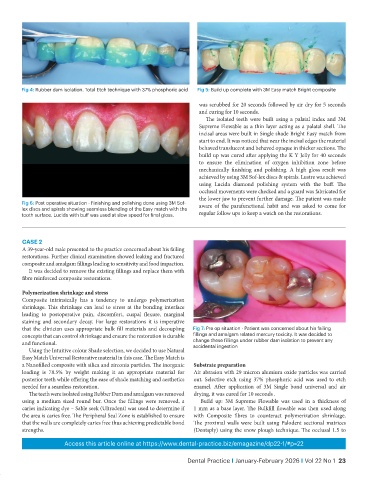
Fig 4: Rubber dam isolation. Total Etch technique with 37% phosphoric acid  Fig 5: Build up complete with 3M Easy match Bright composite

                                                                      was scrubbed for 20 seconds followed by air dry for 5 seconds
                                                                      and curing for 10 seconds.
                                                                         The isolated teeth were built using a palatal index and 3M
                                                                      Supreme Flowable as a thin layer acting as a palatal shell. The
                                                                      incisal areas were built in Single shade Bright Easy match from
                                                                      start to end. It was noticed that near the incisal edges the material
                                                                      behaved translucent and behaved opaque in thicker sections. The
                                                                      build up was cured after applying the K Y Jelly for 40 seconds
                                                                      to ensure the elimination of oxygen inhibition zone before
                                                                      mechanically finishing and polishing. A high gloss result was
                                                                      achieved by using 3M Sof-lex discs & spirals. Lustre was achieved
                                                                      using  Lucida  diamond  polishing  system  with  the buff.  The
                                                                      occlusal movements were checked and a guard was fabricated for
                                                                      the lower jaw to prevent further damage. The patient was made
           Fig 6: Post operative situation - Finishing and polishing done using 3M Sof-  aware of the parafunctional habit and was asked to come for
           lex discs and spirals showing seamless blending of the Easy match with the
           tooth surface. Lucida with buff was used at slow speed for final gloss.  regular follow ups to keep a watch on the restorations.


           CASE 2
           A 39-year-old male presented to the practice concerned about his failing
           restorations. Further clinical examination showed leaking and fractured
           composite and amalgam fillings leading to sensitivity and food impaction.
              It was decided to remove the existing fillings and replace them with
           fibre reinforced composite restorations.

           Polymerization shrinkage and stress
           Composite intrinsically has a tendency to undergo polymerization
           shrinkage. This shrinkage can lead to stress at the bonding interface
           leading to postoperative pain, discomfort, cuspal flexure, marginal
           staining  and  secondary  decay.  For  large  restorations  it  is  imperative
           that the clinician uses appropriate bulk fill materials and decoupling   Fig 7: Pre op situation - Patient was concerned about his failing
           concepts that can control shrinkage and ensure the restoration is durable   fillings and amalgam related mercury toxicity. It was decided to
           and functional.                                          change these fillings under rubber dam isolation to prevent any
                                                                    accidental ingestion
              Using the Intuitive colour Shade selection, we decided to use Natural
           Easy Match Universal Restorative material in this case. The Easy Match is
           a Nanofilled composite with silica and zirconia particles. The inorganic   Substrate preparation
           loading is 78.5% by weight making it an appropriate material for   Air abrasion with 29 micron alumium oxide particles was carried
           posterior teeth while offering the ease of shade matching and aesthetics   out. Selective  etch  using  37% phosphoric acid  was used to  etch
           needed for a seamless restoration.                       enamel. After application of 3M Single bond universal and air
              The teeth were isolated using Rubber Dam and amalgam was removed   drying, it was cured for 10 seconds .
           using a medium sized round bur. Once the fillings were removed, a   Build up: 3M Supreme Flowable was used in a thickness of
           caries indicating dye – Sable seek (Ultradent) was used to determine if   1 mm as a base layer. The Bulkfill flowable was then used along
           the area is caries free. The Peripheral Seal Zone is established to ensure   with Composite fibres to counteract polymerization shrinkage.
           that the walls are completely caries free thus achieving predictable bond   The proximal walls were built using Palodent sectional matrices
           strengths.                                               (Dentsply) using the snow plough technique. The occlusal 1.5 to

                         Access this article online at https://www.dental-practice.biz/emagazine/dp22-1/#p=22

                                                                  Dental Practice I January-February 2026 I Vol 22 No 1  23

