


Page 40 - DP Vol 22 No 1
P. 40
IMPLANTOLOGY


              IMPLANT PLACEMENT AND SIMULTANEOUS GBR


                                                         Yazad Gandhi


           THE SITUATION
           A young male in his 30’s desired a fixed rehabilitation for
           the second quadrant following removal of a failing FPD.
           History revealed a surgical extraction of the maxillary
           third molar in the same quadrant a few years ago.
              Implant placement was carried out with a prosthetic
           stent, hard tissue augmentation was done via direct sinus-
           lift at the same stage using Geistlich Bio-Oss® large particle
           with autogenous cortical shavings from the native site. The
           grafted site was covered using a native collagen barrier,
           Geistlich Bio-Gide®.
              The quadrant was followed up for a period of 6 months
           before commencing the prosthetic phase.

           THE CHALLENGES
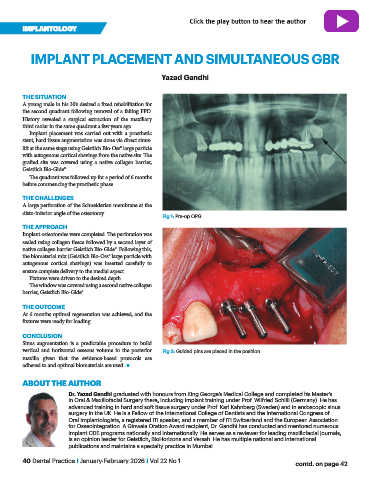
           A large perforation of the Schneiderian membrane at the
           disto-inferior angle of the osteotomy.
                                                          Fig 1: Pre-op OPG
           THE APPROACH
           Implant osteotomies were completed. The perforation was
           sealed using collagen fleece followed by a second layer of
           native collagen barrier Geistlich Bio-Gide®. Following this,
           the biomaterial mix (Geistlich Bio-Oss® large particle with
           autogenous cortical shavings) was  inserted  carefully to
           ensure complete delivery to the medial aspect.
              Fixtures were driven to the desired depth.
              The window was covered using a second native collagen
           barrier, Geistlich Bio-Gide®.

           THE OUTCOME
           At 6 months optimal regeneration was achieved, and the
           fixtures were ready for loading.

           CONCLUSION
           Sinus augmentation is a predictable procedure to build
           vertical and horizontal osseous volume in the posterior   Fig 2: Guided pins are placed in the position
           maxilla given that the evidence-based protocols are
           adhered to and optimal biomaterials are used. n

           ABOUT THE AUTHOR

                          Dr. Yazad Gandhi graduated with honours from King George’s Medical College and completed his Master’s
                          in Oral & Maxillofacial Surgery there, including implant training under Prof. Wilfried Schilli (Germany). He has
                          advanced training in hard and soft tissue surgery under Prof. Karl Kahnberg (Sweden) and in endoscopic sinus
                          surgery in the UK. He is a Fellow of the International College of Dentists and the International Congress of
                          Oral Implantologists, a registered ITI speaker, and a member of ITI Switzerland and the European Association
                          for Osseointegration. A Ginwala Oration Award recipient, Dr. Gandhi has conducted and mentored numerous
                          implant CDE programs nationally and internationally. He serves as a reviewer for leading maxillofacial journals,
                          is an opinion leader for Geistlich, BioHorizons and Versah. He has multiple national and international
                          publications and maintains a specialty practice in Mumbai.
           40 Dental Practice I January-February 2026 I Vol 22 No 1                                   contd. on page 42

