


Page 45 - DP Vol 22 No 1
P. 45
incisors. Mild crowding was noted in the
                                                                                       mandibular anterior region, accompanied
                                                                                       by lingual inclination of teeth 42 and 43.
                                                                                       The maxillary midline was deviated to
                                                                                       the left. Functional assessment revealed
                                                                                       speech difficulty affecting the /s/ and /z/
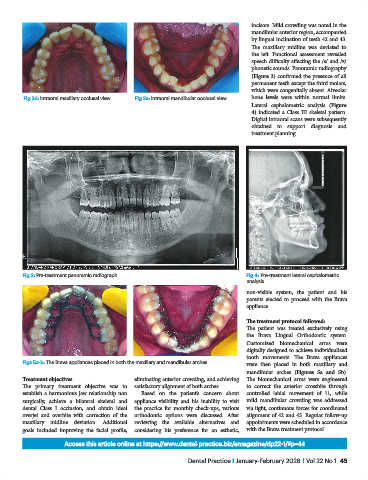
                                                                                       phonetic sounds. Panoramic radiography
                                                                                       (Figure 3) confirmed the presence of all
                                                                                       permanent teeth except the third molars,
                                                                                       which were congenitally absent. Alveolar
           Fig 2d: Intraoral maxillary occlusal view  Fig 2e: Intraoral mandibular occlusal view  bone levels were within normal limits.
                                                                                       Lateral cephalometric analysis  (Figure
                                                                                       4) indicated a Class III skeletal pattern.
                                                                                       Digital intraoral scans were subsequently
                                                                                       obtained to support diagnosis and
                                                                                       treatment planning.


           Fig 3: Pre-treatment panoramic radiograph                                  Fig 4: Pre-treatment lateral cephalometric
                                                                                      analysis
                                                                                      non-visible  system,  the patient  and  his
                                                                                      parents elected to proceed with the Brava
                                                                                      appliance.

                                                                                      The treatment protocol followed:
                                                                                      The patient was treated exclusively using
                                                                                      the Brava Lingual Orthodontic system.
                                                                                      Customized biomechanical arms were
                                                                                      digitally designed to achieve individualized
                                                                                      tooth  movements.  The  Brava  appliances
           Figs 5a-b: The Brava appliances placed in both the maxillary and mandibular arches  were then placed in both maxillary and
                                                                                      mandibular arches  (Figures  5a  and  5b).
           Treatment objectives                  eliminating anterior crowding, and achieving   The biomechanical arms were engineered
           The primary treatment objective was to   satisfactory alignment of both arches.  to correct the anterior crossbite through
           establish a harmonious jaw relationship non   Based on the patient’s concern about   controlled labial movement of 11, while
           surgically, achieve a bilateral skeletal and   appliance  visibility  and  his  inability  to  visit   mild mandibular crowding was addressed
           dental Class I occlusion, and obtain ideal   the practice for monthly check-ups, various   via light, continuous forces for coordinated
           overjet and overbite with correction of the   orthodontic options were  discussed. After   alignment of 42 and 43. Regular follow-up
           maxillary midline deviation. Additional   reviewing the available alternatives and   appointments were scheduled in accordance
           goals included improving the facial profile,   considering his preference for an esthetic,   with the Brava treatment protocol.

                         Access this article online at https://www.dental-practice.biz/emagazine/dp22-1/#p=44

                                                                  Dental Practice I January-February 2026 I Vol 22 No 1  45

