


Page 57 - DP Vol 22 No 1
P. 57
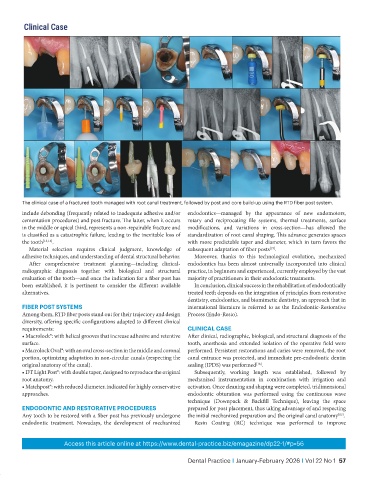
The clinical case of a fractured tooth managed with root canal treatment, followed by post and core build-up using the RTD fiber post system.
           include debonding (frequently related to inadequate adhesive and/or   endodontics—managed by the appearance of new endomotors,
           cementation procedures) and post fracture. The latter, when it occurs   rotary and reciprocating file systems, thermal treatments, surface
           in the middle or apical third, represents a non-repairable fracture and   modifications, and variations in cross-section—has allowed the
           is classified as a catastrophic failure, leading to the inevitable loss of   standardization of root canal shaping. This advance generates spaces
           the tooth [13,14] .                                    with more predictable taper and diameter, which in turn favors the
              Material selection requires clinical judgment, knowledge of   subsequent adaptation of fiber posts .
                                                                                              [15]
           adhesive techniques, and understanding of dental structural behavior.  Moreover, thanks to this technological evolution, mechanized
              After comprehensive treatment planning—including clinical-  endodontics has been almost universally incorporated into clinical
           radiographic diagnosis together with biological and structural   practice, in beginners and experienced, currently employed by the vast
           evaluation of the tooth—and once the indication for a fiber post has   majority of practitioners in their endodontic treatments.
           been  established,  it  is  pertinent  to  consider  the  different  available   In conclusion, clinical success in the rehabilitation of endodontically
           alternatives.                                          treated teeth depends on the integration of principles from restorative
                                                                  dentistry, endodontics, and biomimetic dentistry, an approach that in
           FIBER POST SYSTEMS                                     international literature is referred to as the Endodontic-Restorative
           Among them, RTD fiber posts stand out for their trajectory and design   Process (Endo-Resto).
           diversity, offering specific configurations adapted to different clinical
           requirements:                                          CLINICAL CASE
           • Macrolock®: with helical grooves that increase adhesive and retentive   After clinical, radiographic, biological, and structural diagnosis of the
           surface.                                               tooth, anesthesia and extended isolation of the operative field were
           • Macrolock Oval®: with an oval cross-section in the middle and coronal   performed. Persistent restorations and caries were removed, the root
           portion, optimizing adaptation in non-circular canals (respecting the   canal entrance was protected, and immediate pre-endodontic dentin
           original anatomy of the canal).                        sealing (IPDS) was performed .
                                                                                         [16]
           • DT Light Post®: with double taper, designed to reproduce the original   Subsequently, working length was established, followed by
           root anatomy.                                          mechanized instrumentation in  combination  with irrigation  and
           • Matchpost®: with reduced diameter, indicated for highly conservative   activation. Once cleaning and shaping were completed, tridimensional
           approaches.                                            endodontic obturation was performed using the continuous wave
                                                                  technique (Downpack & Backfill Technique), leaving the space
           ENDODONTIC AND RESTORATIVE PROCEDURES                  prepared for post placement, thus taking advantage of and respecting
           Any tooth to be restored with a fiber post has previously undergone   the initial mechanized preparation and the original canal anatomy .
                                                                                                                    [15]
           endodontic treatment. Nowadays, the development of mechanized   Resin Coating (RC) technique was performed to improve


                         Access this article online at https://www.dental-practice.biz/emagazine/dp22-1/#p=56

                                                                   Dental Practice I January-February 2026 I Vol 22 No 1  57

