


Page 60 - DP Vol 22 No 1
P. 60
IMPLANTOLOGY


              DIGITALLY GUIDED, MINIMALLY INVASIVE


                 FULL-ARCH REHABILITATION IN THREE


                                      DAYS: A CASE REPORT


                                          Gaurav Gupta, D. K. Gupta, Neelja Gupta


           INTRODUCTION
           The evolution of digital technology has transformed the landscape
           of implant dentistry, enabling clinicians to perform highly precise,
           minimally  invasive  procedures  with  enhanced  efficiency  and
           predictability. Traditional full-arch rehabilitation often involves
           multiple visits, surgical flaps, and analogue workflows that can increase
           patient discomfort and risk of complications.
              In contrast, digital tools such as CBCT, intraoral scanners, real-
           time surgical navigation, and CAD/CAM manufacturing have made
           it possible to complete complex treatments in significantly reduced
           timeframes.
              Regarding the use of digital tools, implant dentistry has advanced
           significantly. With 94.5% to 100% cumulative implant survival rates,   Fig 1a
           digital techniques like guided surgery and lately navigated surgery
           provide a potential major improvement in procedural predictability
           and patient safety, enabling positive treatment results in short- and
           mid-term follow-ups. [1,2]
              The use of fully digital workflows, including computer-guided
           implant insertion, digital impressions using intraoral scanners, CAD-
           CAM prostheses, and three-dimensional imaging, is a development in
           implant dentistry. [3]
              The use of ZimVie TSX implants with multi-unit abutments
           facilitated efficient chairside provisionalization, while digital
           verification of fit and occlusion reduced the potential for prosthetic
           misfit. Fully digital fabrication workflows eliminate the inaccuracies
           inherent  to  impression  materials,  casting,  and  model  duplication
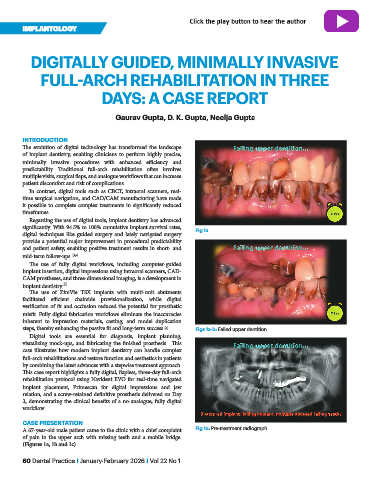
           steps, thereby enhancing the passive fit and long-term success. [4]  Figs 1a-b: Failed upper dentition.
              Digital tools are essential for diagnosis, implant planning,
           visualizing  mock-ups,  and  fabricating  the  finished  prosthesis.    This
           case illustrates how modern implant dentistry can handle complex
           full-arch rehabilitations and restore function and aesthetics in patients
           by combining the latest advances with a stepwise treatment approach.
           This case report highlights a fully digital, flapless, three-day full-arch
           rehabilitation protocol using Navident EVO for real-time navigated
           implant  placement,  Primescan  for  digital  impressions  and  jaw
           relation, and a screw-retained definitive prosthesis delivered on Day
           3, demonstrating the clinical benefits of a no-analogue, fully digital
           workflow.

           CASE PRESENTATION
           A 67-year-old male patient came to the clinic with a chief complaint   Fig 1c: Pre-treatment radiograph
           of pain in the upper arch with missing teeth and a mobile bridge.
           (Figures 1a, 1b and 1c)

           60 Dental Practice I January-February 2026 I Vol 22 No 1

