


Page 62 - DP Vol 22 No 1
P. 62
IMPLANTOLOGY


           TREATMENT WORKFLOW                                       arch denture ready beforehand to avoid any delay
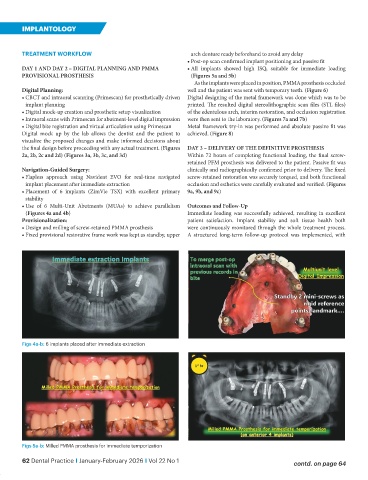
                                                                  •  Post-op scan confirmed implant positioning and passive fit
           DAY 1 AND DAY 2 – DIGITAL PLANNING AND PMMA            •  All implants showed high ISQ, suitable for immediate loading
           PROVISIONAL PROSTHESIS                                   (Figures 5a and 5b)
                                                                     As the implants were placed in position, PMMA prosthesis occluded
           Digital Planning:                                      well and the patient was sent with temporary teeth. (Figure 6)
           •  CBCT and intraoral scanning (Primescan) for prosthetically driven   Digital designing of the metal framework was done which was to be
            implant planning                                      printed. The resulted digital stereolithographic scan files (STL files)
           • Digital mock-up creation and prosthetic setup visualization  of the edentulous arch, interim restoration, and occlusion registration
           • Intraoral scans with Primescan for abutment-level digital impression  were then sent to the laboratory. (Figures 7a and 7b)
           • Digital bite registration and virtual articulation using Primescan  Metal framework try-in was performed and absolute passive fit was
           Digital mock up by the lab allows the dentist and the patient to   achieved. (Figure 8)
           visualize the proposed changes and make informed decisions about
           the final design before proceeding with any actual treatment. (Figures   DAY 3 – DELIVERY OF THE DEFINITIVE PROSTHESIS
           2a, 2b, 2c and 2d) (Figures 3a, 3b, 3c, and 3d)        Within 72 hours of completing functional loading, the final screw-
                                                                  retained PFM prosthesis was delivered to the patient. Passive fit was
           Navigation-Guided Surgery:                             clinically and radiographically confirmed prior to delivery. The fixed
           •  Flapless approach using Navident  EVO for real-time navigated   screw-retained restoration was securely torqued, and both functional
            implant placement after immediate extraction          occlusion and esthetics were carefully evaluated and verified. (Figures
           •  Placement of 6 implants (ZimVie TSX) with excellent primary   9a, 9b, and 9c)
            stability
           •  Use of 6 Multi-Unit Abutments (MUAs) to achieve parallelism   Outcomes and Follow-Up
            (Figures 4a and 4b)                                   Immediate loading was successfully achieved, resulting in excellent
           Provisionalization:                                    patient satisfaction. Implant stability and soft tissue health both
           •  Design and milling of screw-retained PMMA prosthesis  were continuously monitored through the whole treatment process.
           •  Fixed provisional restorative frame work was kept as standby, upper   A structured long-term follow-up protocol was implemented, with


           Figs 4a-b: 6 implants placed after immediate extraction


           Figs 5a-b: Milled PMMA prosthesis for immediate temporization
           62 Dental Practice I January-February 2026 I Vol 22 No 1                                   contd. on page 64

