


Page 9 - Dental Technology June 2022
P. 9
8-12-Zimmermann article-Q8_6-7-8-Ivoclar.qxd  7/13/2022  8:42 PM  Page 2


                                                                                           cosmetic section 09
              DENTAL TECHNOLOGY, APRIL-JUNE 2022


                                                                                   MANUAL OPERATIONS: SET-UP AND TRY-IN IN THE MOUTH
                                                                                   First it was necessary to fabricate a setup, based on prosthetic
                                                                                   fundamentals. For this purpose, classic resin teeth were used.
                                                                                   Teeth  have  a  natural  anatomical  shape  and  you  can  choose
                                                                                   between different morphologies. Within a comparatively short
                                                                                   time, the set up was ready. We intentionally used a charismatic
                                                                                   tooth arrangement, since this emphasizes the individuality of
                                                                                   the patient (Figures 2a and 2b).
                                                                                      Many patients want a well-made prosthesis that functions
                                                                                   well. The dental technician can deliver this criterion using aes-
                                                                                   thetics  and  function  that  are  confirmed  in  the  mouth.  The
                                                                                   patient was satisfied with the final result.

                                                                                   DIGITAL OPERATIONS: MANUFACTURING
                                                                                   Since in the individual "details" of a mounting of teeth activity
                                                                                   dental technician's manual is indispensable, in the realization of
                                                                                   the  travata  we  give  preference  to  the  CAD/CAM  technology.
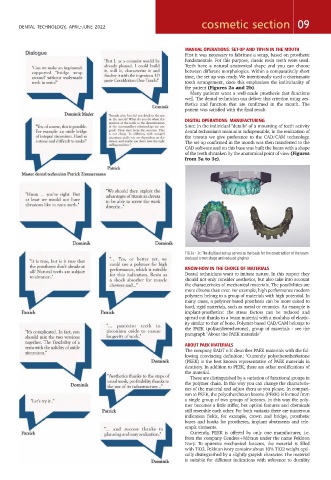
                                                                                   The set-up confirmed in the mouth was then transferred to the
                                                                                   CAD software and on this base was built the beam with a shape
                                                                                   of the teeth shrunken by the anatomical point of view (Figures
                                                                                   from 3a to 3c).


                                                                                    FIG 3a - 3c: The digitized set-up served as the basis for the construction of the beam
                                                                                    (reduced crown shape and reduced gingiva)

                                                                                   KNOW-HOW IN THE CHOICE OF MATERIALS
                                                                                   Dental technicians want to imitate nature. In this respect they
                                                                                   should not only consider aesthetics, but also take into account
                                                                                   the characteristics of mechanical materials. The possibilities are
                                                                                   more diverse than ever. For example, high performance modern
                                                                                   polymers belong to a group of materials with high potential. In
                                                                                   many cases, a polymer-based prosthesis can be more suited to
                                                                                   hard, rigid materials, such as metal or ceramics. An example is
                                                                                   implant-prosthetics:  the  stress  factors  can  be  reduced  and
                                                                                   spread out thanks to a beam material with a modulus of elastic-
                                                                                   ity similar to that of bone. Polymer-based CAD/CAM belongs to
                                                                                   the  PAEK  (polyaryleterchetone),  group  of  materials  -  see  the
                                                                                   paragraph "About the PAEK materials"

                                                                                   ABOUT PAEK MATERIALS
                                                                                   The company EADT e.V. describes PAEK materials with the fol-
                                                                                   lowing convincing definition: "Currently polyetheretherketone
                                                                                   (PEEK) is the best known representative of PAEK materials in
                                                                                   dentistry. In addition to PEEK, there are other modifications of
                                                                                   the material.
                                                                                      These are distinguished by a variation of functional groups in
                                                                                   the polymer chain. In this way you can change the characteris-
                                                                                   tics of the material and adjust them as you please. In compari-
                                                                                   son to PEEK, the polyethercheton ketone (PEKK) is formed from
                                                                                   a single group of two groups of ketones. In this way the poly-
                                                                                   mer becomes a little stiffer, but optical features and chemicals
                                                                                   still resemble each other. For both variants there are numerous
                                                                                   indication  fields,  for  example,  crown  and  bridge,  prosthetic
                                                                                   bases and hooks for prostheses, implant abutments and tele-
                                                                                   scopic elements.
                                                                                      Currently,  PEKK  is  offered  by  only  one  manufacturer,  i.e.
                                                                                   from the company Cendres+Métaux under the name Pekkton
                                                                                   Ivory.  To  optimize  mechanical  features,  the  material  is  filled
                                                                                   with TiO2. Pekkton ivory contains about 10% TiO2 weight opti-
                                                                                   cally distinguished by a slightly grayish character. The material
                                                                                   is suitable for different indications with reference to ductility

