


Page 11 - Dental Technology June 2022
P. 11
8-12-Zimmermann article-Q8_6-7-8-Ivoclar.qxd  7/13/2022  8:43 PM  Page 4


                                                                                           cosmetic section 11
              DENTAL TECHNOLOGY, APRIL-JUNE 2022


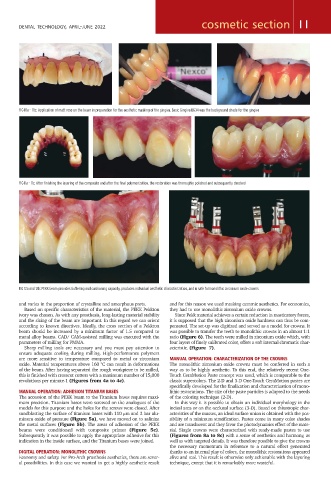
              FIG 10a - 10c: Application of matt rose on the beam in preparation for the aesthetic masking of the gingiva. Basic Gingiva BG34 was the background shade for the gingiva


              FIG 11a - 11c: After finishing the layering of the composite and after the final polymerization, the restoration was thoroughly polished and subsequently checked


              FIG 12a and 12b: PEKK beam provides buffering and cushioning capacity, produces individual aesthetic characterization, and is safe formonolithic zirconium oxide crowns


              and varies in the proportion of crystalline and amorphous parts.  and for this reason we used masking ceramic aesthetics. For economics,
                Based on specific characteristics of the material, the PEKK Pekkton  they had to use monolithic zirconium oxide crowns.
              ivory was chosen. As with any prosthesis, long-lasting material stability  Since Pekk material achieves a certain reduction in masticatory forces,
              and the sizing of the beam are important. In this regard we can orient  it is supposed that the high zirconium oxide hardness can thus be com-
              according to known directives. Ideally, the cross section of a Pekkton  pensated. The set-up was digitized and served as a model for crowns. It
              beam should be increased by a minimum factor of 1.5 compared to  was possible to transfer the teeth to monolithic crowns in an almost 1:1
              metal alloy beams. CAD/ CAM-assisted milling was executed with the  ratio (Figure 6). The teeth were milled in zirconium oxide which, with
              parameters of milling for PMMA.                                four layers of finely calibrated color, offers a soft internal chromatic char-
                Sharp  milling  tools  are  necessary  and  you  must  pay  attention  to  acteristic. (Figure  7).
              ensure  adequate  cooling  during  milling.  High-performance  polymers
              are  more  sensitive  to  temperature  compared  to  metal  or  zirconium  MANUAL OPERATION: CHARACTERIZATION OF THE CROWNS
              oxide. Material temperatures above 160 °C can result in deformations  The monolithic zirconium oxide crowns must be conferred in such a
              of the beam. After having separated the rough workpiece to be milled,  way as to be highly aesthetic. To this end, the relatively recent One-
              this is finished with crosscut cutters with a maximum number of 15,000  Touch CeraMotion Paste concept was used, which is comparable to the
              revolutions per minute-1 (Figures from 4a to 4c).              classic supercolors. The 2-D and 3-D One-Touch CeraMotion pastes are
                                                                             specifically developed for the finalization and characterization of mono-
              MANUAL OPERATION: ADHESION TITANIUM BASES                      lithic restorations. The size of the paste particles is adapted to the needs
              The accession of the PEKK beam to the Titanium bases requires maxi-  of the coloring technique (2-D).
              mum precision. Titanium bases were screwed on the analogues of the  In this way it is possible to obtain an individual morphology in the
              models for this purpose and the holes for the screws were closed. After  incisal area or on the occlusal surface (3-D). Based on thixotropic char-
              sandblasting the surface of titanium bases with 110 µm and 3 bar alu-  acteristics of the masses, an ideal surface union is obtained with the pos-
              minum oxide of pressure (Figure 5a), we have moved on to salinize  sibility of a minimum stratification. Pastes come in many color shades
              the metal surfaces (Figure 5b). The areas of adhesion of the PEKK  and are translucent and they favor the photodynamics effect of the mate-
              beams  were  conditioned  with  composite  primer  (Figure  5c).  rial. Single crowns were characterized with ready-made pastes to use
              Subsequently it was possible to apply the appropriate adhesive for this  (Figures from 8a to 8c) with a sense of aesthetics and harmony, as
              indication in the inside surface, and the Titanium bases were joined.  well as with targeted details. It was therefore possible to give the crowns
                                                                             the  necessary  momentum  in  reference  to  a  natural  effect  generated
              DIGITAL OPERATION: MONOLITHIC CROWNS                           thanks to an internal play of colors, the monolithic restorations appeared
              Economy and safety. For Pro-Arch prosthesis aesthetics, there are sever-  alive and real. This result is otherwise only achievable with the layering
              al possibilities. In this case we wanted to get a highly aesthetic result  technique, except that it is remarkably more wasteful.

