


Page 14 - Dental Technology 12-3
P. 14
14-16-Rhein article-Q8_6-7-8-Ivoclar.qxd  10/6/2022  8:38 PM  Page 1


              14 prosthetic section                                                            DENTAL TECHNOLOGY, JULY-SEPTEMBER 2022


                             A HYBRID SOLUTION USING PRECISION


                        ATTACHMENT AND CONVENTIONAL CLASP


                 SYSTEM INCORPORATED WITH AN OBTURATOR


               FOR CLASS 1 POSTERIOR END SADDLE SITUATION


                                                 A LABORATORY PROTOCOL


                                           CLINICAL PROCEDURES: PROF. DR T.V PADMANABHAN
                                           LABORATORY WORK: NANDHA KUMAR C.D.T / CADET


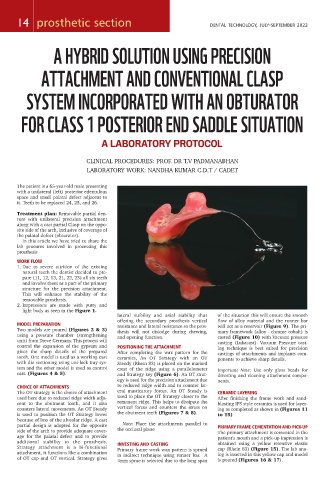
              The patient is a 65-year-old male presenting
              with a unilateral (left) posterior edentulous
              space and small palatal defect adjacent to
              it. Teeth to be replaced 24, 25, and 26.

              Treatment plan: Removable partial den-
              ture  with  unilateral  precision  attachment
              along with a cast partial Clasp on the oppo-
              site side of the arch, inclusive of coverage of
              the palatal defect (obturator).
                In this article we have tried to share the
              lab  procures  involved  in  processing  this
              prosthesis

              WORK FLOW
              1. Due  to  severe  attrition  of  the  existing
                natural teeth the dentist decided to pre-
                pare (11, 12, 13, 21, 22, 23) all six teeth
                and involve them as a part of the primary
                structure  for  the  precision  attachment.
                This  will  enhance  the  stability  of  the
                removable prosthesis.
              2. Impressions  are  made  with  putty  and
                light body as seen in the Figure 1.
                                                        lateral  stability  and  axial  stability  thus  of the situation this will ensure the smooth
                                                        offering  the  secondary  prosthesis  vertical  flow  of  alloy  material  and  the  runner  bar
              MODEL PREPARATION                         resistance and lateral resistance so the pros-  will act as a reservoir (Figure 9). The pri-
              Two models are poured (Figures 2 & 3)     thesis  will  not  dislodge  during  chewing,  mary framework (alloy - chrome cobalt) is
              using  a  pressure  chamber  (strengthening  and opening function.                  casted (Figure 10) with Vacuum pressure
              unit) from Dreve Germany. This process will                                         casting  (Lukacast).  Vacuum  Pressure  cast-
              control  the  expansion  of  the  gypsum  and  POSITIONING THE ATTACHMENT           ing  technique  is  best  suited  for  precision
              gives  the  sharp  details  of  the  prepared  After  completing  the  wax  pattern  for  the  castings of attachments and implants com-
              tooth. One model is used as a working cast  ceramics,  An  OT  Strategy  with  an  OT  ponents to achieve sharp details.
              with die sectioning using uni-lock tray sys-  Steady (Rhein 83) is placed on the marked
              tem and the other model is used as control  crest  of  the  ridge  using  a  parallelometer  Important  Note: Use  only  glass  beads  for
              cast. (Figures 4 & 5).                    and Strategy key (Figure 6). An OT strat-  divesting and cleaning attachment compo-
                                                        egy is used for the precision attachment due  nents.
              CHOICE OF ATTACHMENTS                     to reduced ridge width and to counter lat-
              The OT strategy is the choice of attachment  eral  masticatory  forces.  An  OT  Steady  is  CERAMIC LAYERING
                                                        used to place the OT Strategy closer to the
              used here due to reduced ridge width adja-                                          After  finishing  the  frame  work  and  sand-
              cent  to  the  abutment  tooth,  and  it  also  remanent ridge. This helps to dissipate the  blasting IPS style ceramics is used for layer-
              counters lateral movements. An OT Steady  vertical  forces  and  counters  the  stress  on  ing as completed as shown in (Figures 11
              is  used  to  position  the  OT  Strategy  lower  the abutment teeth (Figures 7 & 8).  to 15)
              because of loss of the alveolar ridge. A cast
              partial  design  is  adopted  for  the  opposite  Note: Place  the  attachments  parallel  to  PRIMARY FRAME CEMENTATION AND PICK-UP
              side of the arch to provide adequate cover-  the occlusal plane                     The primary attachment is cemented in the
              age  for  the  palatal  defect  and  to  provide
                                                                                                  patient’s mouth and a pick-up impression is
              additional  stability  to  the  prosthesis.  INVESTING AND CASTING                  obtained  using  a  yellow  retentive  elastic
              Strategy  attachment  is  a  bi-functional  Primary frame work wax pattern is sprued  cap (Rhein 83) (Figure 15). The lab ana-
              attachment, it functions like a combination  in indirect technique using runner bar.  A  log is inserted in this yellow cap and model
              of OT cap and OT vertical. Strategy gives
                                                        4mm sprue is selected due to the long span  is poured (Figures 16 & 17).

