


Page 8 - DT 13-1 March 2023
P. 8
8-12-Mdt. Milos Miladinov-Q8_6-7-8-Ivoclar.qxd  3/27/2023  12:51 PM  Page 1


              08 cosmetic section                                                             DENTAL TECHNOLOGY, JANUARY-MARCH 2023


                                              DIGITAL AND ANALOG…


                                      FOR AN OUTSTANDING RESULT


                                                            MDT. MILOS MILADINOV

                The case we present here was solved with the highest precision that digital can provide com-
              bined with "the art of making by hand." For a long time, I tried to take impressions and then print
                          a Geller model, and duplicate refractory matrices - however, without success.


              For  the  patient  who  came  to  us,  we
              used the MEDIT i500 intraoral scanner
              and  the  AFT  facial  scanner  since  we
              wanted to integrate very accurate data
              into Exocad to create a predictable and
              repeatable result.
                Once all the data were acquired, we
              proceeded  to  design  her  new  smile
              using  various  tooth  libraries  available
              in  Exocad.  Below  we  will  show  the
              step-by-step  procedures.  The  facial
              scanner has become a must in our lab-
              oratory because of the highly accurate
              data that we can use to place the intra-
              oral  scans  of  the  patient  onto  the  3D
              photo  of  his  or  her  head.  Using  scan
              files  of  the  mouth  and  head,  we  can  FIG 1
              superimpose  all  4  scans  of  the  face
              (See  Figures  4  through 7) and use                                            preparation  under  the  gums  as  with  an  analog
              them as a digital facial arch to position                                       impression,  where  the  use  of  retraction  cord  is
              the  jaw  in  the  scanned  head.  In  this                                     strongly recommended when preparing and tak-
              way we can make a predictable design                                            ing the impression.
              without fear of creating tilted restora-                                          The greatest opportunity is to make a model
              tions, sloping lines, etc.                                                      with  some  refractory  preparations.  In  this  case
                We apply the silicone impression on                                           you can see that we use the printer not only for
              this scan and insert it into the mouth.                                         this, but also to print "test veneers trials," to be
              Once the material is cured, we remove                                           used to "sell" this treatment to the patient; if we
              it and scan it using the intraoral scan-                                        get her approval, we can move to the next step
              ner in order to send the scan as an STL                                         and create the final veneers.
              file to the laboratory so that they can                                           Once  approval  has  been  obtained  from  the
              overlay  it  with  the  intraoral  scan  in                                     patient, we proceed to print the final Geller mas-
              Exocad. In this way we get an accurate                                          ter  model  and  duplicate  the  matrices  with  the
              position of the jaw in the 3D head.                                             special Shera Refractory material. Since this is a
                Intraoral  scanning  was  performed                                           no-prep case, we will make ultra-thin refractory
              with a MEDIT i500 in HD for an extra  FIG 2              FIG 3                  veneers  using  Style  Ceramic  from  Ivoclar
              precise impression. The scan is fast, in
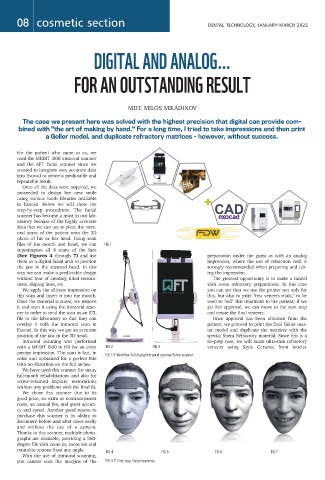
                                                   FIG 1-3: Workflow Full digital/Intraoral scanner/Facial scanner
              color and optimized for a perfect bite
              with no distortion on the full arches.
                We have used this scanner for many
              full-mouth rehabilitations and also for
              screw-retained  implant  restorations
              without any problems with the final fit.
                We  chose  this  scanner  due  to  its
              good price, no extra or nontransparent
              costs, no annual fee, and great accura-
              cy and speed. Another good reason to
              purchase  this  scanner  is  its  ability  to
              document before and after cases easily
              and  without  the  use  of  a  camera.
              Thanks to this scanner, multiple photo-
              graphs are available, providing a 360-
              degree file with zoom in, zoom out and
              rotatable options from any angle.
                                                   FIG 4                  FIG 5                  FIG 6                  FIG 7
                With  the  use  of  intraoral  scanning,
              you  cannot  scan  the  margins  of  the  FIG 4-7: First step. Facial scanning

