


Page 20 - DT 15-1
P. 20
10-21-Claudio_6-7-8-Ivoclar.qxd  01-05-2025  07:56  Page 11


               20 prosthetic section                                                          DENTAL TECHNOLOGY, JANUARY-MARCH 2025


              FIG 94: Cemented work in anterior view 81  FIG 95-96: Details of the locking, with and without the  FIG 96
                                                        framework inserted in the oral cavity


             FIG 97: Final control radiographic status  FIG 98-99: Before and after images with peri-oral tissues  FIG 99


                                                                             ing  impression  using  an  individual  tray  for  the  fabrication  of  the
                                                                             framework (Figure 79).
                                                                               In the laboratory, customization continues with the coloring of zir-
                                                                             conia. When particular esthetic needs arise, we perform a cut-back of
                                                                             the  vestibular  surfaces  and  layer  dedicated  feldspathic  ceramic
                                                                             (Figure 80).
                                                                               Next, the metal sheaths are glued into the prepared recesses, and
                                                                             the OT Cap Micro attachments are screwed in (these are interchange-
                                                                             able) (Figures 81 to 83).
                                                                               Then, we fabricate the framework, preparing two hard wax blocks
                                                                             with reference notches, while on the antagonist we apply a 0.5 mm
                                                                             thermoformed sheet (Figures 84 and 85). The clinician conducts the
                                                                             final test and registration using self-curing resin (Luxabite) to finalize
                                                                             the work (Figure 86).
                                                                               The  position  is  checked  on  the  working  models  and  everything
                                                                             matches  perfectly,  thanks  to  the  transfer  system  described  earlier
                                                                             (Figure 87). We proceed with assembling the upper posterior teeth
              FIG 100-101: Pictures before and after with intraoral tissues  in  composite  on  the  framework,  customizing  and  integrating  them
                                                                             with  the  previous  reconstructions  (Figure  88).  Retention  attach-
                                                                             ments and Teflon inserts are then placed in dedicated containers to
                                                                             provide the patient with a stable, yet removable prosthesis (Figure
                                                                             89).
                                                                               These images demonstrate that even using monolithic material, if
                                                                             properly  and  carefully  processed,  can  yield  aesthetically  pleasing
                                                                             results (Figures 90 and 91).
                                                                               From a functional perspective, however, there is no comparison to
                                                                             conventional layering techniques. While we have long used verticula-
                                                                             tors, wax duplications, and molding methods, we now find that mod-
                                                                             eling  in  wax  and  transforming  it  into  zirconia  represents  the  most
                                                                             ergonomic and predictable approach. Even the composite teeth on the
                                                                             framework  are  customized  using  colored  resins  (Optiglaze,  GC)
                                                                             (Figures 92 and 93).
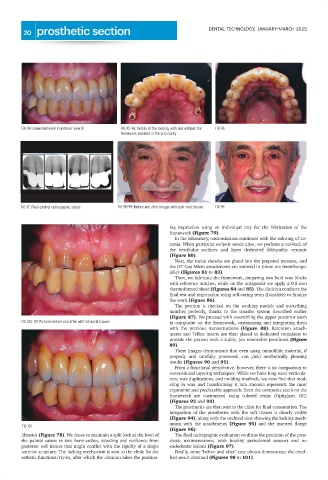
                                                                               The prosthetics are then sent to the clinic for final cementation. The
                                                                             integration  of  the  prosthetics  with  the  soft  tissues  is  clearly  visible
                                                                             (Figure 94), along with the occlusal view showing the locking mech-
                                                                             anism  with  the  attachments  (Figure  95) and  the  inserted  flange
              FIG 101
                                                                             (Figure 96).
              libraries (Figure 78). We chose to maintain a split lock at the level of  The final radiographic evaluation confirms the precision of the pros-
              the palatal suture in two hemi-arches, avoiding any resilience from  thetic  reconstructions,  with  healthy  periodontal  support  and  no
              posterior soft tissues that might conflict with the rigidity of a single  endodontic lesions (Figure 97).
              anterior structure. The locking mechanism is sent to the clinic for the  Finally, some "before and after" case photos demonstrate the excel-
              esthetic-functional try-in, after which the clinician takes the position-  lent result obtained (Figures 98 to 101).

