


Page 16 - DT 15-1
P. 16
10-21-Claudio_6-7-8-Ivoclar.qxd  01-05-2025  07:56  Page 7


               16 prosthetic section                                                          DENTAL TECHNOLOGY, JANUARY-MARCH 2025


                After isolating the teeth with Vaseline to facilitate easy removal, the  41 to 43).
              self-curing material (Luxatemp, DMG—or alternatives) is placed inside  Upon receiving both patient approval and satisfactory esthetic and
              the templates.                                                 functional  outcomes,  we  can  confidently  affirm  that  the  project  is
                Once the mock-up is molded, the patient can directly perceive the  essentially complete.
              intended result.                                                 All  critical  components—Esthetics,  Function,  Perioral  Integration,
                The  clinician  can  verify  esthetic  integration,  perform  phonetic  and Occlusion—are defined. From this point forward, the only focus is
              assessments, and confirm mock-up harmony within the oral environ-  on accurately transferring these designs into temporaries and subse-
              ment (Figures 35 and 36).                                      quently into final restorations.
                The esthetic transformation is evident, particularly in views with  The last task is reconstruction of the upper posterior sectors through
              perioral soft tissues (Figures 37 and 38).                     anatomical tooth mounting.
                At this point, the clinician also assesses whether centric relation cor-  However, it becomes clear at this design stage that in addition to
              responds to the laboratory-defined position (Figures  39  and 40),  anterior assembly (and anterior guide reconstruction), it is absolutely
              and checks protrusive and lateral mandibular movements (Figures  necessary to rehabilitate the lower occlusion.


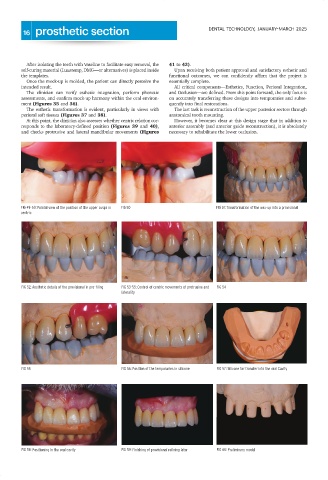
              FIG 49-50: Palatal view of the position of the upper cusps in  FIG 50              FIG 51: Transformation of the wax-up into a provisional
              centric


              FIG 52: Aesthetic details of the provisional in pre-filing  FIG 53-55: Control of centric movements of protrusive and  FIG 54
                                                         laterality


              FIG 55                                     FIG 56: Position of the temporaries in silicone  FIG 57: Silicone for transfer into the oral Cavity


              FIG 58: Positioning in the oral cavity     FIG 59: Finishing of provisional relining later  FIG 60: Preliminary model

