


Page 18 - DT 15-1
P. 18
10-21-Claudio_6-7-8-Ivoclar.qxd  01-05-2025  07:56  Page 9


               18 prosthetic section                                                          DENTAL TECHNOLOGY, JANUARY-MARCH 2025


                Without this, we risk creating incongruent upper anatomical and  In this way, the clinician can directly restore the optimum condition
              morphological curves.                                          that was designed in the laboratory (Figures 65 and 66). Moreover,
                For the lower wax-up, we use another SAM articulator accessory  in this specific case—compared to when reconstructing arches on nat-
              that helps define the Occlusal Plane (Figure 44).              ural teeth—there is no need to use specific techniques to create inter-
                The inclination of this plate relative to the Frankfurt Plane deter-  proximal separations for the passage of dental floss, as this is a pros-
              mines the occlusal course, which varies by skeletal class.     thesis.
                In this case—a normotypic Class I—we set the inclination at 12° to  After the time required for tissue healing following abutment prepa-
              the Frankfurt Plane (Figure 45), a value derived from Prof. Slavicek’s  ration, we proceed to the next phase. Since the prosthetic abutments
              extensive case database of 5,500 records.                      judged maintainable do not require endodontic, restorative, or peri-
                Alternatively, individualized occlusal planes can be determined via  odontal therapy, we are ready to take the final impressions: one upper,
              cephalometric analysis of a lateral teleradiograph.            one of the provisional tested by the patient, and one of the antago-
                Curves of Spee and Wilson are also considered. These may be gen-  nist—all with precision materials (Figure 67).
              erated using pre-made templates, but we prefer to design them indi-  To preserve the vertical dimension of occlusion (DVO), the inter-
              vidually using the linear plate as a reference (Figure 46).    maxillary position and anterior guides are tested with the temporaries
                The diagnostic wax-up is completed with the upper posterior assem-  to perform the registration. We make use of the temporaries them-
              bly (Figures 47 and 48), ensuring that the palatal cusps align per-  selves and proceed with the following technique:
              fectly within the fossae of the lower teeth (Figures 49 and 50).  We disassemble one provisional hemi-arch while the other is left in
                Given that the patient did not necessarily request a fixed upper pros-  position, and we take the registration between the abutments and the
              thesis—which would require complex and lengthy implant therapy—  antagonist arch teeth (Figure 68).
              and  considering  the  presence  of  a  removable  prosthesis  on  tapered  We then disassemble the other hemi-arch, leaving the registration
              crowns in the lower arch, the proposed prosthetic plan is as follows:  we just made in place, and record the relationship between the abut-
                                                                             ments and the teeth on the opposite side (Figure 69).
              UPPER ARCH                                                       In this way, we ensure that the laboratory receives the intermaxil-
              • Monolithic zirconia blocking 1.3 to 2.4 with Rhein83 extra-coronal  lary relationship in exactly the same position as the temporary in the
               attachments.                                                  oral cavity.
              • Framed with a palatine bar and composite teeth.                In  the  laboratory,  we  articulate  the  upper  model  with  the  lower
                                                                             model using the registration (Figure 70). What we observe is a per-
              LOWER ARCH                                                     fect match between the registration taken in the oral cavity and the
              • Reconstruction  of  anatomical  ideal  in  molded  composite  on  the  position of the master models on the articulator (Figure 71).
               existing teeth of the removable denture.                        We can then proceed with the execution of the final work using the
                Then, once the shaping and transformation of the wax-up into resin  information  from  the  provisional,  which—let  us  not  forget—was
              is carried out in acrylic for the fabrication of the temporary in the pre-  checked by the clinician and tested by the patient for a period that may
              liminary (Figures 51 and 52), we proceed with the resining of the  vary from one to three months.
              upper temporary with hooks. Consequently, we perform the control of  By mounting the model of the temporaries, we can exactly repro-
              the protrusive and lateral movements on the articulator (Figures 53  duce both esthetics and function, as validated in the functional mouth
              to 55). At this point, it is of paramount importance that the clinician  (Figures 72 and 73).
              inserts the temporary and transfers the lower wax-up in exactly the  In addition, through the incisal table, we can execute and verify the
              same modality as they were made in the laboratory.             guiding paths of centric, protrusive, and lateral movements, with the
                For the correct placement of the fixed temporary, we prepare a rigid  same inclination checked and tested on the patient (Figure 74).
              silicone template (90 Shore) made on the original (unwaxed) antago-  For those accustomed to functionalizing the temporaries, the infor-
              nist model. This is stable and precise and is interposed between the  mation  gathered  can  be  transferred  directly  to  the  definitive  recon-
              arches to lock the temporary in the position in which it was made on  struction.
              the articulator relative to the antagonist (Figures 56 and 57). This  In this case, after waxing, we preferred to use the “Double Scan”
              device allows the clinician to insert the provisional into the oral cavity  technique, though it is also possible to use digital capture techniques
              in exactly the same position as it was made in the laboratory—a step  by matching the temporaries.
              of paramount importance (Figures 58 and 59). Then, to allow the  Through the technique we have used daily for years—processing
              clinician to reconstruct the abutments in the oral cavity in a propor-  pre-sintered zirconia (green phase)—we precisely define the transition
              tionally correct manner, we prepare the model on which the predeter-  lines,  occlusal  surfaces,  emergence  profiles,  and  surface  textures
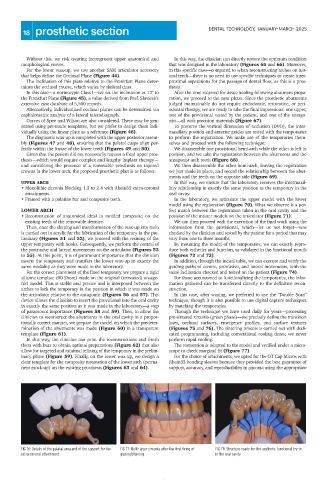
              mination of the abutments was made (Figure 60) in a transparent  (Figures 75 and 76). The sintering process is carried out with dedi-
              template (Figure 61).                                          cated programming, including conventional cooling times; we never
                In this way, the clinician can print the reconstructions and finish  perform rapid cooling.
              them with burs to obtain optimal preparations (Figure 62) that also  The restoration is adapted to the model and verified under a micro-
              allow for targeted and minimal relining of the temporary in the prelim-  scope to check marginal fit (Figure 77).
              inary phase (Figure 59). Finally, on the lower wax-up, we design a  For the choice of attachments, we opted for the OT Cap Micros with
              clear template for the composite restoration of the lower arch (perma-  Rhein83 bonding sleeves because they provided the best guarantee of
              nent mock-up) on the existing prosthesis (Figures 63 and 64).  support, accuracy, and reproducibility in zirconia using the appropriate


              FIG 76: Details of the palatal area and of the support for the  FIG 77: Multi-layer zirconia after the first firing of  FIG 78: Structure ready for the aesthetic functional try-in
              extra coronal attachment                  glazing/staining                         in the oral cavity

