


Page 20 - DT Vol 15 No 3
P. 20
20   I prosthodontics                                                      DENTAL TECHNOLOGY, JULY-SEPTEMBER 2025


                  DIGITAL FAST-TRACK IMPLANT-SUPPORTED PROSTHETIC


               REHABILITATION: A CASE FROM TOOTHWORKS DENTAL LAB


                                                   PANKAJ GUPTA, DHANASHREE MINASE


             INTRODUCTION
             This article highlights the successful oral rehabilitation of a
             Sanskrit teacher who was experiencing impaired mastication
             and poor phonetics due to multiple missing teeth. A complete
             prosthodontic workflow utilizing digital techniques was carried
             out at Toothworks Dental Lab in Nagpur, Maharashtra.. The
             process minimized the number of patient visits by combining
             scanning and jaw relation in a single appointment, followed by a
             PMMA trial to confirm phonetics. Subsequent steps, including
             the metal and bisque trials and final prosthesis delivery,
             were completed within the dental laboratory itself, ensuring
             efficiency, precision, and patient comfort.

             CASE BACKGROUND
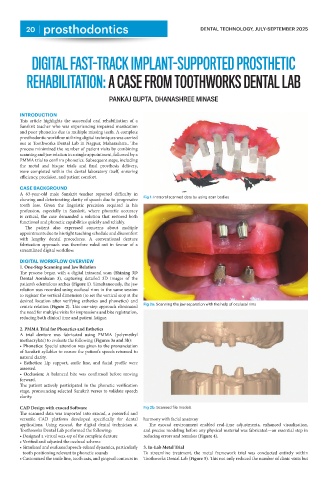
             A  63-year-old  male  Sanskrit  teacher  reported  difficulty  in   Fig 1: Intraoral scanned data by using scan bodies
             chewing and deteriorating clarity of speech due to progressive
             tooth loss. Given the linguistic precision required in his
             profession,  especially  in Sanskrit, where  phonetic  accuracy
             is critical, the case demanded a solution that restored both
             functional and phonetic capabilities quickly and reliably.
               The patient also expressed concerns about multiple
             appointments due to his tight teaching schedule and discomfort
             with lengthy dental procedures. A conventional denture
             fabrication approach was therefore ruled out in favour of a
             streamlined digital workflow.
             DIGITAL WORKFLOW OVERVIEW
             1. One-Step Scanning and Jaw Relation
             The  process  began  with  a  digital  intraoral  scan  (Shining 3D
             Dental Aoralscan 3),  capturing  detailed  3D  images  of  the
             patient’s edentulous arches (Figure 1). Simultaneously, the jaw
             relation was recorded using occlusal rims in the same session
             to register the vertical dimension (to set the vertical stop at the
             desired location after verifying esthetics  and phonetics) and   Fig 2a: Scanning the jaw separation with the help of occlusal rims
             centric relation (Figure 2). This one-step approach eliminated
             the need for multiple visits for impressions and bite registration,
             reducing both clinical time and patient fatigue.

             2. PMMA Trial for Phonetics and Esthetics
             A trial denture was fabricated using PMMA (polymethyl
             methacrylate) to evaluate the following (Figures 3a and 3b):
             • Phonetics: Special attention was given to the pronunciation
             of Sanskrit syllables to ensure the patient’s speech returned to
             natural clarity.
             •  Esthetics:  Lip support, smile line, and facial profile were
             assessed.
             •  Occlusion: A balanced bite was confirmed before moving
             forward.
             The patient actively participated in the phonetic verification
             stage, pronouncing selected Sanskrit verses to validate speech
             clarity.

             CAD Design with exocad Software                     Fig 2b: Scanned file models
             The scanned data was imported into exocad, a powerful and
             versatile CAD platform developed specifically for dental   harmony with facial anatomy
             applications. Using exocad, the digital dental technician at   The exocad environment enabled real-time adjustments, enhanced visualization,
             Toothworks Dental Lab performed the following:      and precise modeling before any physical material was fabricated—an essential step in
             • Designed a virtual wax-up of the complete denture  reducing errors and remakes (Figure 4).
             • Verified and adjusted the occlusal scheme
             •  Simulated and evaluated speech-related dynamics, particularly   3. In-Lab Metal Trial
              tooth positioning relevant to phonetic sounds      To streamline treatment, the metal framework trial was conducted entirely within
             • Customized the smile line, tooth axis, and gingival contours in   Toothworks Dental Lab (Figure 5). This not only reduced the number of clinic visits but

