


Page 24 - DT Vol 15 No 3
P. 24
24   I aesthetics                                                          DENTAL TECHNOLOGY, JULY-SEPTEMBER 2025


                HARMONY: MULTILAYER ZIRCONIA IN DAILY USE IN


                            THE LABORATORY SELECTION CRITERIA


                                                               CARSTEN FISCHER


             The modern daily life of the laboratory is characterized by a wide variety of materials
             and products. Especially in the case of relatively new materials (e.g., zirconium
             oxide), however, the choice can become difficult. This article discusses zirconium
             multilayer and highlights the  essential factors  to  consider when  choosing.  The
             focus is on the production of beams for microstratification, where the term truss
             is imprecise in this context. Eighty to ninety percent of a multilayer restoration
             is zirconium oxide. This forms the base for shaping and staining. Therefore, the
             choice and the exact colour are of great importance. In the laboratory, we still work
             according to a conventional colour scale (classical Vita colour scale). But does a
             zirconium oxide A3 really correspond to the A3 of the colour scale?

             THE HISTORY OF ZIRCONIUM OXIDE
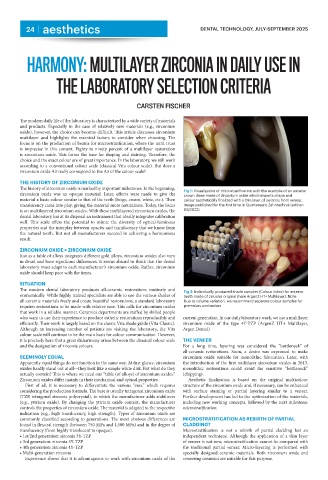
             The history of zirconium oxide is marked by important milestones. In the beginning,   Fig 1: Visualization of microstratification with the example of an anterior
             zirconium oxide was an opaque material. Later, efforts were made to give the   crown. Base made of zirconium oxide which imparts shape and
             material a basic colour similar to that of the teeth (beige, cream, white, etc.). Then   colour aesthetically finalized with a thin layer of ceramic from veneer.
             translucency came into play, giving the material more naturalness. Today, the focus   Image published for the first time in Quintessenz Zahntechnik (edition
             is on multilayered zirconium oxides. With these multilayered zirconium oxides, the   09/2022)
             dental laboratory has at its disposal an instrument that ideally integrates calibration
             well. This scale offers the potential to mimic the diversity of optical-luminous
             properties and the interplay between opacity and translucency that we know from
             the natural tooth. But not all manufacturers succeed in achieving a harmonious
             result.

             ZIRCONIUM OXIDE ≠ ZIRCONIUM OXIDE
             Just as a table of alloys integrates different gold alloys, zirconium oxides also vary
             in detail and have significant differences. It seems absurd to think that the dental
             laboratory must adapt to each manufacturer’s zirconium oxide. Rather, zirconium
             oxide should keep pace with the times.
             SITUATION
             The modern dental laboratory produces all-ceramic restorations routinely and   Fig 2: Individually produced shade samples (Colour Index) for anterior
             economically. While highly trained specialists are able to use the various shades of   teeth made of zirconia original (here ArgenZ HT+ Multilayer). Note:
             all-ceramic materials freely and create beautiful restorations, a standard laboratory   Due to volume variation, we recommend separate colour samples for
             requires restorations to be made with relative ease. This calls for zirconium oxides   premolars and molars
             that work in a reliable manner. Ceramics departments are staffed by skilled people
             who want to use their experience to produce esthetic restorations reproducibly and   current generation. In our daily laboratory work, we use a multilayer
             efficiently. Their work is largely based on the classic Vita shade guide (Vita Classic).   zirconium oxide of the type 4Y-TZP (ArgenZ HT+ Multilayer,
             Although an increasing number of patients are visiting the laboratory, the Vita   Argen Dental).
             colour scale will continue to be the main basis for colour communication. However,
             it is precisely here that a great disharmony arises between the classical colour scale   THE VENEER
             and the designation of zirconia colours.                             For a long time, layering was considered the “bottleneck” of
                                                                                  all-ceramic  restorations.  Soon,  a  desire  was  expressed  to  make
             SEEMINGLY EQUAL                                                      zirconium oxide suitable for monolithic fabrication. Later, with
             Apparently equal things do not function in the same way. At first glance, zirconium   the introduction of the first multilayer zirconium oxides in 2013,
             oxides hardly stand out at all—they look like a simple white disk. But what do they   monolithic  restorations  could  avoid  the  sensitive  “bottleneck”
             actually contain? This is where we need our “table (of alloys) of zirconium oxides.”   (chipping).
             Zirconium oxides differ mainly in their mechanical and optical properties.  Aesthetic finalization is based on the original multicolour
               First of all, it is necessary to differentiate the various “eras,” which requires   structure of the zirconium oxide and, if necessary, can be enhanced
             considering the production formula. The base is usually tetragonal zirconium oxide   with surface staining or partial layering similar to a veneer.
             (TZP, tetragonal zirconia polycrystal), to which the manufacturer adds stabilizers   Further development has led to the optimization of the materials,
             (e.g., yttrium oxide). By changing the yttrium oxide content, the manufacturer   including new working concepts, followed by the next milestone:
             controls the properties of zirconium oxide. The material is adapted to the respective   microstratification.
             indication (e.g., high translucency, high  strength). Types of zirconium oxide are
             commonly classified according to generations. The most obvious differences are   MICROSTRATIFICATION AS REBIRTH OF PARTIAL
             found in flexural strength (between 750 MPa and 1,500 MPa) and in the degree of   CLADDING?
             translucency (from highly translucent to opaque).                    Microstratification  is  not  a  rebirth  of  partial  cladding  but  an
             • 1st/2nd generation: zirconia 3Y-TZP                                independent  technique.  Although  the  application  of  a  thin  layer
             • 3rd generation: zirconia 5Y-TZP                                    of veneer is not new, microstratification cannot be compared with
             • 4th generation: zirconia 4Y-TZP                                    the traditional partial veneer. Micro-layering is performed with
             • Multi-generation zirconia                                          specially designed ceramic materials. Both zirconium oxide and
               Experience shows that it is advantageous to work with zirconium oxide of the   veneering ceramics are suitable for this purpose.

