


Page 48 - DP.qxd
P. 48
IMPLANTOLOGY    secTION


              “ENHANCiNG PRECiSiON iN DENTAL


                    iMPLANT iMPRESSiONS: A novel


              technique for deeply placed implant”


                                                           Gopal Goel


           Ensuring a precise fit between dental implants and the
           superstructure (prosthesis or supported framework) is vital
           for the long term success of implants and implant-supported
           prosthesis.
              There are several factors which need to be taken care of, for
           long term success of implants and implant supported prosthetic
           complex. One factor which may influence the accuracy of the
           definitive prosthesis is the stability and accurate pickup of the
           impression coping in polymerised impression material.
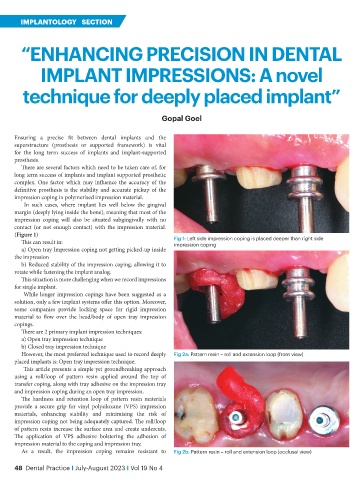
               In such cases, where implant lies well below the gingival
           margin (deeply lying inside the bone), meaning that most of the
           impression coping will also be situated subgingivally with no
           contact (or not enough contact) with the impression material.
           (Figure 1)
              This can result in:                              Fig 1: Left side impression coping is placed deeper than right side
                                                               impression coping
              a) Open tray Impression coping not getting picked-up inside
           the impression
              b) Reduced stability of the impression coping, allowing it to
           rotate while fastening the implant analog.
              This situation is more challenging when we record impressions
           for single implant.
               While longer impression copings have been suggested as a
           solution, only a few implant systems offer this option. Moreover,
           some companies provide locking space for rigid impression
           material to flow over the head/body of open tray impression
           copings.
              There are 2 primary implant impression techniques:
              a) Open tray impression technique
              b) Closed tray impression technique
              However, the most preferred technique used to record deeply   Fig 2a: Pattern resin – roll and extension loop (front view)
           placed implants is: Open tray impression technique.
               This article presents a simple yet groundbreaking approach
           using a roll/loop of pattern resin applied around the top of
           transfer coping, along with tray adhesive on the impression tray
           and impression coping during an open tray impression.
              The hardness and retention loop of pattern resin materials
           provide a secure grip for vinyl polysiloxane (VPS) impression
           materials, enhancing stability and minimising the risk of
           impression coping not being adequately captured. The roll/loop
           of pattern resin increase the surface area and create undercuts.
           The application of VPS adhesive bolstering the adhesion of
           impression material to the coping and impression tray.
              As a result, the impression coping remains resistant to   Fig 2b: Pattern resin – roll and extension loop (occlusal view)

           48  Dental Practice i July-August 2023 i Vol 19 No 4

