


Page 44 - DP.qxd
P. 44
Implantology   sectIon


              Putty Assisted Sinus Augmentation:


                  The “Pasa Technique” Discussion


                                and A Descriptive Case


                    Lanka Mahesh, Glenn Mascarenhas, Sagrika Shukla, Tanvi Paliwal, Zara Dhawan


           ABSTRACT
           GBR with bone graft for sinus augmentation are well established
           techniques in implant dentistry. Technique based on PASS
           principle has predictable regeneration and wound healing after
           implant placement. Implant design and its surface characteristics
           also play a major role when sinus augmentation and implants are
           placed simultaneously.

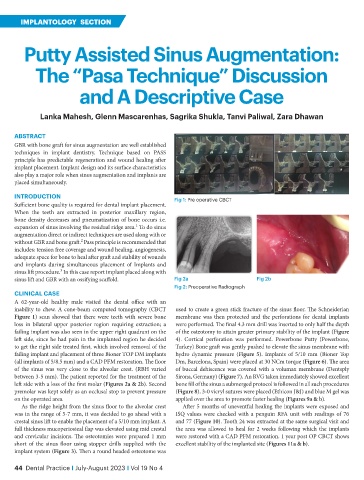
           iNTRODUCTiON                                        Fig 1: Pre operative CBCT
           Sufficient bone quality is required for dental implant placement.
           When the teeth are extracted in posterior maxillary region,
           bone density decreases and pneumatization of bone occurs i.e.
                                                  1
           expansion of sinus involving the residual ridge area.  To do sinus
           augmentation direct or indirect techniques are used along with or
                                 2
           without GBR and bone graft.  Pass principle is recommended that
           includes: tension free coverage and wound healing, angiogenesis,
           adequate space for bone to heal after graft and stability of wounds
           and implants during simultaneous placement of Implants and
                          3
           sinus lift procedure.  In this case report implant placed along with
           sinus lift and GBR with an ossifying scaffold.      Fig 2a                    Fig 2b
                                                               Fig 2: Preoperative Radiograph
           CLiNiCAL CASE
           A  62-year-old  healthy  male  visited  the  dental  office  with  an
           inability to chew. A cone-beam computed tomography (CBCT   used to create a green stick fracture of the sinus floor. The Schneiderian
           Figure 1) scan showed that there were teeth with severe bone   membrane was then protected and the perforations for dental implants
           loss in  bilateral  upper posterior region  requiring extraction; a   were performed. The final 4.3 mm drill was inserted to only half the depth
           failing implant was also seen in the upper right quadrant on the   of the osteotomy to attain greater primary stability of the implant (Figure
           left side, since he had pain in the implanted region he decided   4). Cortical perforation was performed. Powerbone Putty (Powerbone,
           to get the right side treated first, which involved removal of the   Turkey) Bone graft was gently pushed to elevate the sinus membrane with
           failing implant and placement of three Bioner TOP DM implants   hydro dynamic pressure  (Figure 5). Implants of 5/10 mm (Bioner Top
           (all implants of 5/8.5 mm) and a CAD PFM restoration. The floor   Dm, Barcelona, Spain) were placed at 30 NCm torque (Figure 6). The area
           of the sinus was very close to the alveolar crest. (RBH varied   of buccal dehiscence was covered with a volumax membrane (Dentsply
           between 3-5 mm). The patient reported for the treatment of the   Sirona, Germany) (Figure 7). An RVG taken immediately showed excellent
           left side with a loss of the first molar (Figures 2a & 2b). Second   bone fill of the sinus a submerged protocol is followed in all such procedures
           premolar was kept solely as an occlusal stop to prevent pressure   (Figure 8). 3-0 vicryl sutures were placed (Ethicon J&J) and blue M gel was
           on the operated area.                               applied over the area to promote faster healing (Figures 9a & b).
              As the ridge height from the sinus floor to the alveolar crest   After 5 months of uneventful healing the implants were exposed and
           was in the range of 5-7 mm, it was decided to go ahead with a   ISQ values were checked with a penguin RFA unit with readings of 76
           crestal sinus lift to enable the placement of a 5/10 mm implant. A   and 77 (Figure 10). Tooth 24 was extracted at the same surgical visit and
           full thickness mucoperiosteal flap was elevated using mid crestal   the area was allowed to heal for 2 weeks following which the implants
           and crevicular incisions. The osteotomies were prepared 1 mm   were restored with a CAD PFM restoration. 1 year post OP CBCT shows
           short of the sinus floor using stopper drills supplied with the   excellent stability of the implanted site (Figures 11a & b).
           implant system (Figure 3). Then a round headed osteotome was

           44  Dental Practice i July-August 2023 i Vol 19 No 4

