


Page 53 - DP.qxd
P. 53
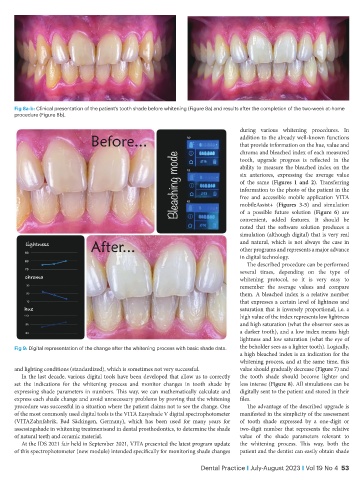
Fig 8a-b: Clinical presentation of the patient’s tooth shade before whitening (Figure 8a) and results after the completion of the two-week at-home
           procedure (Figure 8b).

                                                                                    during various whitening procedures. In
                                                                                    addition to the already well-known functions
                                                                                    that provide information on the hue, value and
                                                                                    chroma and bleached index of each measured
                                                                                    tooth, upgrade progress is reflected in the
                                                                                    ability to measure the bleached index on the
                                                                                    six anteriores, expressing the average value
                                                                                    of the same  (Figures 1 and 2). Transferring
                                                                                    information to the photo of the patient in the
                                                                                    free and accessible mobile application VITA
                                                                                    mobileAssist+  (Figures 3-5)  and simulation
                                                                                    of a possible future solution  (Figure 6) are
                                                                                    convenient, added features. It should be
                                                                                    noted that the software solution produces a
                                                                                    simulation (although digital) that is very real
                                                                                    and natural, which is not always the case in
                                                                                    other programs and represents a major advance
                                                                                    in digital technology.
                                                                                      The described procedure can be performed
                                                                                    several times, depending on the type of
                                                                                    whitening protocol, so it is very easy to
                                                                                    remember the average values and compare
                                                                                    them. A bleached index  is a relative number
                                                                                    that expresses a certain level of lightness and
                                                                                    saturation that is inversely proportional, i.e. a
                                                                                    high value of the index represents low lightness
                                                                                    and high saturation (what the observer sees as
                                                                                    a darker tooth), and a low index means high
                                                                                    lightness and low saturation (what the eye of
           Fig 9: Digital representation of the change after the whitening process with basic shade data.  the beholder sees as a lighter tooth). Logically,
                                                                                    a high bleached index is an indication for the
                                                                                    whitening process, and at the same time, this
           and lighting conditions (standardized), which is sometimes not very successful.    value should gradually decrease (Figure 7) and
              In the last decade, various digital tools have been developed that allow us to correctly   the tooth shade should become lighter and
           set the indications for the whitening process and monitor changes in tooth shade by   less intense (Figure 8). All simulations can be
           expressing shade parameters in numbers. This way, we can mathematically calculate and   digitally sent to the patient and stored in their
           express each shade change and avoid unnecessary problems by proving that the whitening   files.
           procedure was successful in a situation where the patient claims not to see the change. One   The advantage of the described upgrade is
           of the most commonly used digital tools is the VITA Easyshade V digital spectrophotometer   manifested in the simplicity of the assessment
           (VITAZahnfabrik,  Bad  Säckingen,  Germany),  which  has  been  used  for  many  years  for     of tooth shade expressed by a one-digit or
           assessingshade in whitening treatmentsand in dental prosthodontics, to determine the shade   two-digit number that represents the relative
           of natural teeth and ceramic material.                                   value of the shade parameters relevant to
              At the IDS 2021 fair held in September 2021, VITA presented the latest program update   the  whitening  process.  This  way, both the
           of this spectrophotometer (new module) intended specifically for monitoring shade changes   patient and the dentist can easily obtain shade

                                                                        Dental Practice i July-August 2023 i Vol 19 No 4  53

