


Page 42 - DP20-2.qxd
P. 42
implantology section


                PROSTHETIC REHABLITATION WITH


              DENTAL IMPLANTS AFTER EFFECTIVE


                  CONSERVATIVE MANAGEMENT OF


                AMELOBLASTOMA: A CASE REPORT


                                   Gaurav Gupta, D.K. Gupta, Neelja Gupta, Richa Gupta


           INTRODUCTION                           Ameloblastomas are frequently not   80%  of  ameloblastomas  are  located  in  the
           Ameloblastomas are benign yet locally   diagnosed in their initial stages and are more   (posterior)  mandible,  although the cause is
           invasive tumors, derived from the odontogenic   commonly discovered incidentally due to the   unknown. In extremely rare cases, primary
           epithelium, and are found most frequently   absence of symptoms. Their slow growth often   sinonasal ameloblastomas have also been
           in the mandible. No gender predilection   manifests as painless, gradually enlarging   reported. Post-surgical defects may need
           is described, and a higher prevalence is   swellings. Furthermore, additional symptoms   reconstruction, which can be achieved by
           observed between the 3rd and 4th decades   such as loose teeth, malocclusion, nasal   flaps or bone regeneration materials. Dental
           of life. Uncontrolled growth of this massive   obstruction, and pain may also be present.  implants are the primary treatment of choice
           lesion can cause destructive results, leading to   These tumors very rarely show metastasis   for the prosthetic rehabilitation.
           compromised aesthetics.              (malignant ameloblastoma). More than   The aim of this article is to present a


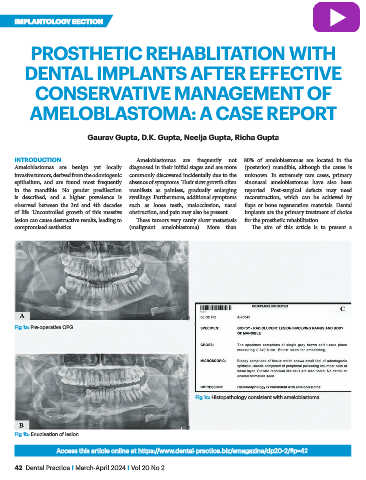
           Fig 1a: Pre-operative OPG


                                                                     Fig 1c: Histopathology consistent with ameloblastoma


           Fig 1b: Enucleation of lesion

                         Access this article online at https://www.dental-practice.biz/emagazine/dp20-2/#p=42

           42  Dental Practice I March-April 2024 I Vol 20 No 2

