


Page 44 - DP20-2.qxd
P. 44
implantology section


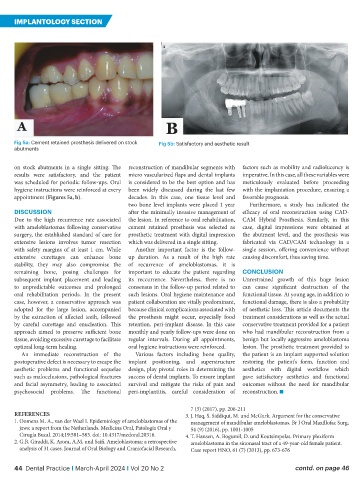
           Fig 5a: Cement retained prosthesis delivered on stock   Fig 5b: Satisfactory and aesthetic result
           abutments

           on stock abutments in a single sitting. The   reconstruction of mandibular segments with   factors such as mobility and radiolucency is
           results were satisfactory, and the patient   micro vascularized flaps and dental implants   imperative. In this case, all these variables were
           was scheduled for periodic follow-ups. Oral   is considered to be the best option and has   meticulously evaluated before proceeding
           hygiene instructions were reinforced at every   been widely discussed during the last few   with the implantation procedure, ensuring a
           appointment (Figures 5a, b).         decades. In this case, one tissue level and   favorable prognosis.
                                                two bone level implants were placed 1 year   Furthermore, a study has indicated the
           DISCUSSION                           after the minimally invasive management of   efficacy of oral reconstruction using CAD-
           Due to the high recurrence rate associated   the lesion. In reference to oral rehabilitation,   CAM Hybrid Prosthesis. Similarly, in this
           with ameloblastomas following conservative   cement retained prosthesis was selected as   case, digital impressions were obtained at
           surgery, the established standard of care for   prosthetic treatment with digital impression   the abutment level, and the prosthesis was
           extensive lesions involves tumor resection   which was delivered in a single sitting.   fabricated via CAD/CAM technology in a
           with safety margins of at least 1 cm. While   Another important factor is the follow-  single  session,  offering  convenience  without
           extensive curettages can enhance bone   up duration. As a result of the high rate   causing discomfort, thus saving time.
           stability, they may also compromise the   of recurrence of  ameloblastomas,  it  is
           remaining bone, posing challenges for   important to educate the patient regarding   CONCLUSION
           subsequent implant placement and leading   its reccurrence. Nevertheless,  there is no   Unrestrained growth of this huge lesion
           to unpredictable outcomes and prolonged   consensus in the follow-up period related to   can cause significant destruction of the
           oral rehabilitation periods. In the present   such lesions. Oral hygiene maintenance and   functional tissue. At young age, in addition to
           case, however, a conservative approach was   patient collaboration are vitally predominant,   functional damage, there is also a probability
           adopted for the large lesion, accompanied   because clinical complications associated with   of aesthetic loss. This article documents the
           by the extraction of affected teeth, followed   the prosthesis might occur, especially food   treatment considerations as well as the actual
           by careful curettage and enucleation. This   retention, peri-implant disease. In this case   conservative treatment provided for a patient
           approach aimed to preserve sufficient bone   monthly and yearly follow-ups were done on   who had mandibular reconstruction from a
           tissue, avoiding excessive curettage to facilitate   regular  intervals.  During  all  appointments,   benign but locally aggressive ameloblastoma
           optimal long-term healing.           oral hygiene instructions were reinforced.  lesion. The prosthetic treatment provided to
              An immediate reconstruction  of  the   Various factors including bone quality,   the patient is an implant supported solution
           postoperative defect is necessary to escape the   implant positioning, and superstructure   restoring the patient’s form, function and
           aesthetic problems and functional sequelae   design, play pivotal roles in determining the   aesthetics with digital workflow which
           such as malocclusions, pathological fractures   success of dental implants. To ensure implant   gave satisfactory aesthetics and functional
           and facial asymmetry, leading to associated   survival and mitigate the risks of pain and   outcomes without the need for mandibular
           psychosocial problems. The functional   peri-implantitis, careful consideration of   reconstruction. n


                                                                    7 (3) (2017), pp. 206-211
           REFERENCES                                             3.  J. Haq, S. Siddiqui, M. und McGurk. Argument for the conservative
           1.  Oomens M. A., van der Waal I. Epidemiology of ameloblastomas of the   management of mandibular ameloblastomas. Br J Oral Maxillofac Surg,
             jaws; a report from the Netherlands. Medicina Oral, Patología Oral y   54 (9) (2016), pp. 1001-1005
             Cirugía Bucal. 2014;19:581–583. doi: 10.4317/medoral.20316.   4.   T. Hansen, A. Bogumil, D. und Koutsimpelas. Primary plexiform
           2.  G.B. Giraddi, K. Arora, A.M. und Saifi. Ameloblastoma: a retrospective   ameloblastoma in the sinonasal tract of a 49-year-old female patient.
             analysis of 31 cases. Journal of Oral Biology and Craniofacial Research,   Case report HNO, 61 (7) (2013), pp. 673-676

           44  Dental Practice I March-April 2024 I Vol 20 No 2                                       contd. on page 46

