


Page 39 - DP20-2.qxd
P. 39
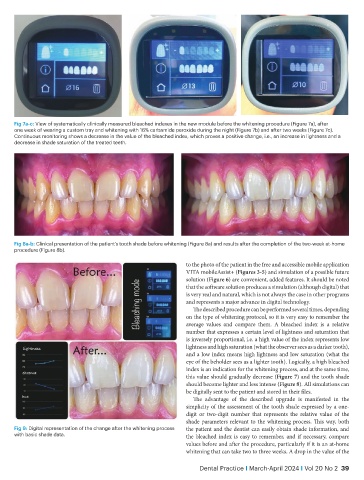
Fig 7a-c: View of systematically clinically measured bleached indexes in the new module before the whitening procedure (Figure 7a), after
           one week of wearing a custom tray and whitening with 16% carbamide peroxide during the night (Figure 7b) and after two weeks (Figure 7c).
           Continuous monitoring shows a decrease in the value of the bleached index, which proves a positive change, i.e., an increase in lightness and a
           decrease in shade saturation of the treated teeth.


           Fig 8a-b: Clinical presentation of the patient’s tooth shade before whitening (Figure 8a) and results after the completion of the two-week at-home
           procedure (Figure 8b).

                                                                   to the photo of the patient in the free and accessible mobile application
                                                                   VITA mobileAssist+ (Figures 3-5) and simulation of a possible future
                                                                   solution (Figure 6) are convenient, added features. It should be noted
                                                                   that the software solution produces a simulation (although digital) that
                                                                   is very real and natural, which is not always the case in other programs
                                                                   and represents a major advance in digital technology.
                                                                     The described procedure can be performed several times, depending
                                                                   on the type of whitening protocol, so it is very easy to remember the
                                                                   average values and compare them. A bleached index is a relative
                                                                   number that expresses a certain level of lightness and saturation that
                                                                   is inversely proportional, i.e. a high value of the index represents low
                                                                   lightness and high saturation (what the observer sees as a darker tooth),
                                                                   and a low index means high lightness and low saturation (what the
                                                                   eye of the beholder sees as a lighter tooth). Logically, a high bleached
                                                                   index is an indication for the whitening process, and at the same time,
                                                                   this value should gradually decrease (Figure 7) and the tooth shade
                                                                   should become lighter and less intense (Figure 8). All simulations can
                                                                   be digitally sent to the patient and stored in their files.
                                                                     The advantage of the described upgrade is manifested in the
                                                                   simplicity of the assessment of the tooth shade expressed by a one-
                                                                   digit  or  two-digit  number  that  represents  the  relative  value  of  the
                                                                   shade parameters relevant to the whitening process. This way, both
           Fig 9: Digital representation of the change after the whitening process   the patient and the dentist can easily obtain shade information, and
           with basic shade data.                                  the bleached index is easy to remember, and if necessary, compare
                                                                   values before and after the procedure, particularly if it is an at-home
                                                                   whitening that can take two to three weeks. A drop in the value of the

                                                                       Dental Practice i March-April 2024 i Vol 20 No 2  39

