


Page 48 - DP Vol 20 No 3
P. 48
Sleep dentiStry Section


              THE SMYLIST POSITIONER – AN AMAZING


            CONCEPT TO HELP TREAT AND POSITIVELY


                        INFLUENCE CHRONIC PROBLEMS


                                                 Maria Csillag and Ajay Kakar

           Smylist is a term used to describe a unique and comprehensive
           approach in dentistry. It perfectly blends aesthetics and function
           to achieve a harmonious smile tailored to individual parameters.
           This method ensures the harmonious operation of all involved
           muscles, influencing the entire face. Specifically, it considers
           the muscles of mastication, mimic muscles, the tongue, and the
           muscles under the mandible.
              Smylist  emphasizes  that  the  balance  of  mimic  and  chewing
           muscles is key not only to achieving a balanced mandibular
           position and harmonious occlusion (Balanced Occlusal Position),
           but also to ensuring a relaxed face and temporomandibular joint
           (TMJ). Moreover, this balance positively affects the muscles of the
           entire body.

              Observations of Smylist when the muscles are working in a   Fig 1a
           relaxed way:
           •  The  blood  circulation  of  the  tissues  significantly  improves,
             resulting in shinier, softer skin with fewer wrinkles, pimples/
             acnes, and hypokeratotic dots. The turgor pressure also increases.
           •  The release of nerve compression by stressed muscles alleviates
             unexplainable pains or makes them significantly milder.
           •  The lymphatic system becomes more effective, leading to visibly
             softer and healthier skin.
           •  The  facial  muscles  relax,  working  symmetrically,  which  can
             resolve facial asymmetry and make older faces appear much
             younger.
           •  Spasms in the chewing and neck muscles are relieved.
           •  A positive cascade effect can be observed throughout the body,
             starting with the neck, shoulders, back, thoracic regions, chest,   Fig 1b
             hips, legs, knees, and feet.

              In  fact,  “The  Smylist  positioner”  is  a panacea for  various
           situations that are often accepted as untreatable problems. These
           issues  are  typically limited to pain  management or  symptom
           control without complete resolution.
              Some problems can be traced back to persistent, long-term
           muscle spasms where tissues, bones, and areas are compressed
           and function less optimally. Improper blood flow and circulation
           cause hypo-oxygenation of the tissue, acidity, higher CO  levels,
                                                       2
           and scarring on the skin surface. Asymmetrically working muscles
           keep the mandible in an incorrect, rotated, or tilted position,
           known as a Forced Mandibular Position (FMP). This position
           leads to muscle spasms, shrinkage, and overstretched muscles on   Fig 1c
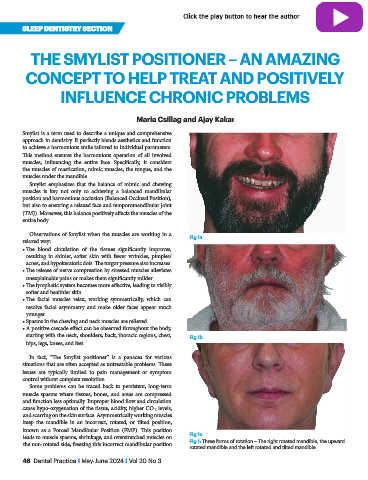
           the non-rotated side, freezing this incorrect mandibular position   Fig 1: Three forms of rotation – The right rotated mandible, the upward
                                                                   rotated mandible and the left rotated and tilted mandible
           46  Dental Practice I May-June 2024 I Vol 20 No 3

