


Page 50 - DP Vol 20 No 3
P. 50
Sleep dentiStry Section


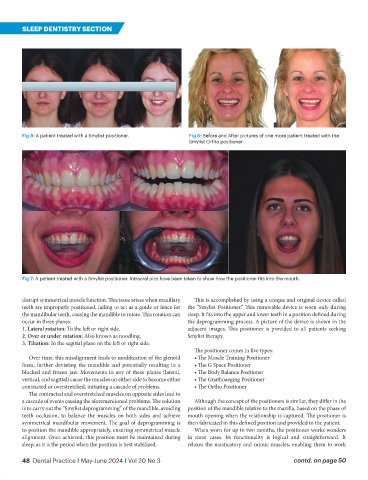
           Fig 5: A patient treated with a Smylist positioner.     Fig 6: Before and After pictures of one more patient treated with the
                                                                   Smylist Ortho positioner


           Fig 7: A patient treated with a Smylist positioner. Intraoral pics have been taken to show how the positioner fits into the mouth.


           disrupt symmetrical muscle function. This issue arises when maxillary   This is accomplished by using a unique and original device called
           teeth are improperly positioned, failing to act as a guide or fence for   the “Smylist Positioner.” This removable device is worn only during
           the mandibular teeth, causing the mandible to rotate. This rotation can   sleep. It fits into the upper and lower teeth in a position defined during
           occur in three planes:                                 the deprogramming process. A picture of the device is shown in the
           1. Lateral rotation: To the left or right side.        adjacent  images. This positioner is  provided to all  patients seeking
           2. Over or under rotation: Also known as noodling.     Smylist therapy.
           3. Tiltation: In the sagittal plane on the left or right side.
                                                                     The positioner comes in five types:
              Over time, this misalignment leads to modification of the glenoid   • The Muscle Training Positioner
           fossa,  further  deviating  the  mandible  and  potentially  resulting  in  a   • The G Space Positioner
           blocked and frozen jaw. Movements in any of these planes (lateral,   • The Body Balance Positioner
           vertical, and sagittal) cause the muscles on either side to become either   • The Gnathoaeging Positioner
           contracted or overstretched, initiating a cascade of problems.  • The Ortho Positioner
              The contracted and overstretched muscles on opposite sides lead to
           a cascade of events causing the aforementioned problems. The solution   Although the concept of the positioners is similar, they differ in the
           is to carry out the “Smylist deprogramming” of the mandible, avoiding   position of the mandible relative to the maxilla, based on the phase of
           teeth occlusion, to balance the muscles on both sides and achieve   mouth opening when the relationship is captured. The positioner is
           symmetrical mandibular movement. The goal of deprogramming is   then fabricated in this defined position and provided to the patient.
           to position the mandible appropriately, ensuring symmetrical muscle   When worn for up to two months, the positioner works wonders
           alignment. Once achieved, this position must be maintained during   in most cases. Its functionality is logical and straightforward. It
           sleep, as it is the period when the position is best stabilized.  relaxes the masticatory and mimic muscles, enabling them to work

           48  Dental Practice I May-June 2024 I Vol 20 No 3                                          contd. on page 50

