


Page 62 - DP Vol 20 No 3
P. 62
IMPLANT DENTISTRY SECTION


                    RETRIEVAL OF FRACTURED IMPLANT


                ABUTMENT SCREW USING OSSTEM ESR


                                        KIT: A CASE REPORT


                                                         Amit Bhardwaj


           INTRODUCTION
           Implant therapy is an effective and reliable restorative treatment
           option.
           The success of dental implants is based primarily on the extent of
           osseointegration.
           Implant restorations can fail either biologically or mechanically.
           a.  Biological factors include unsuccessful osseointegration or the
             presence of peri-implantitis.
           b.  Mechanical failures include crown fracture, framework fracture,
             screw loosening, and screw fracture.
              •  A  loose  screw  is  more  prone  to  excessive  sideways  load.
              Fracture of the implant abutment screw can be a serious
              problem as the fragment remaining inside the implant may
              prevent the implant from functioning efficiently.
              •  Though  implant  abutment  screw  fracture  is  uncommon
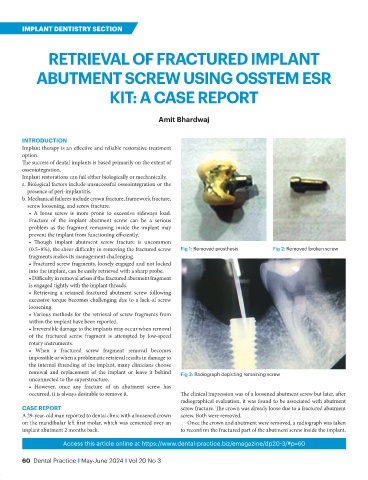
              (0.5–8%), the sheer difficulty in removing the fractured screw   Fig 1: Removed prosthesis  Fig 2: Removed broken screw
              fragments makes its management challenging.
              • Fractured screw fragments, loosely engaged and not locked
              into the implant, can be easily retrieved with a sharp probe.
              • Difficulty in removal arises if the fractured abutment fragment
              is engaged tightly with the implant threads.
              •  Retrieving  a  retained  fractured  abutment  screw  following
              excessive torque becomes challenging due to a lack of screw
              loosening.
              • Various methods for the retrieval of screw fragments from
              within the implant have been reported.
              • Irreversible damage to the implants may occur when removal
              of the fractured screw fragment is attempted by low-speed
              rotary instruments.
              •  When  a  fractured  screw  fragment  removal  becomes
              impossible or when a problematic retrieval results in damage to
              the internal threading of the implant, many clinicians choose
              removal and replacement of the implant or leave it behind   Fig 3: Radiograph depicting remaining screw
              unconnected to the superstructure.
              •  However,  once  any  fracture  of  an  abutment  screw  has
              occurred, it is always desirable to remove it.    The clinical impression was of a loosened abutment screw but later, after
                                                                radiographical evaluation, it was found to be associated with abutment
           CASE REPORT                                          screw fracture. The crown was already loose due to a fractured abutment
           A 29-year-old man reported to dental clinic with a loosened crown   screw. Both were removed.
           on the mandibular left first molar, which was cemented over an   Once the crown and abutment were removed, a radiograph was taken
           implant abutment 2 months back.                      to reconfirm the fractured part of the abutment screw inside the implant.

                         Access this article online at https://www.dental-practice.biz/emagazine/dp20-3/#p=60

           60  Dental Practice I May-June 2024 I Vol 20 No 3

