


Page 12 - DP Vol 20 No 4 HR
P. 12
PEDIATRIC DENTISTRY SECTION


             INTERCEPTIONS IN PEDIATRIC DENTISTRY


                                                         PART II


                            POST TRAUMA DENTAL RECONSTRUCTIONS


                                                   Ritu Ahal and Rajesh Ahal


           INTRODUCTION                                           for achieving relatively long-term results. Recent advancements in
           The pediatric dentist plays a crucial role in managing dental trauma   composite technology, particularly the development of multi-shaded
           in children, particularly during high-risk periods such as the   composites, offer substantial evidence-based benefits. These newer
           “terrible  twos,” adolescence,  and  as the  child  matures.  Immediate   materials enable clinicians to perform biomimetic restorations of
           treatment of traumatized deciduous and/or permanent teeth, ideally   anterior teeth, providing superior aesthetic outcomes and enhanced
           within the first hour—known as the  Golden Hour—is critical for   durability.
           optimizing successful outcomes. Prompt intervention during this   Biomimetic reconstruction techniques using these advanced
           period significantly enhances the likelihood of successful recovery,   composites are more conservative and minimally invasive compared
           highlighting the importance of timely awareness and action.  to traditional crown placements. They offer increased strength and
              In cases of dental trauma, reattachment of fractured tooth fragments   longevity, approaching the performance of prosthetic restorations.
           is a viable and effective treatment option. This article presents clinical   The clinical cases presented herein will demonstrate the efficacy of
           cases demonstrating the long-term success of reattached dental   biomimetic reconstruction techniques and their durability, which is
           fragments. Contrary to the common belief that all traumatized   comparable to that of prosthetic alternatives.
           teeth necessitate endodontic treatment followed by the placement of
           a crown, it is important to recognize that dental pulp, initially in a
           state of shock following trauma, often recovers if further trauma is
           prevented. Typically, pulp healing occurs within 21 to 28 days. Warm
           saline mouth rinses can support this process if initiated after 24 hours
           post-trauma. Endodontic intervention, if deemed necessary, should
           be deferred for 3-4 weeks to allow for potential pulp recovery, unless
           there is a definite pulpal or periapical involvement.
              Furthermore, it is advisable to avoid placing crowns on traumatized
           teeth until the growth and development of the dentition are complete
           and occlusion is stable. In the interim, fractured teeth can be restored
           using modern composites, which, when applied according to proper
           protocols, provide durable and effective results. Although the use of a
           rubber dam is beneficial for isolation, maintaining rigorous isolation
           protocols without a rubber dam can still yield satisfactory outcomes.

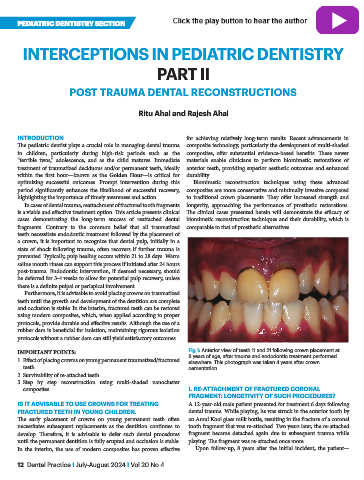
           IMPORTANT POINTS:                                       Fig 1: Anterior view of teeth 11 and 21 following crown placement at
           1.  Effect of placing crowns on young permanent traumatized/fractured   8 years of age, after trauma and endodontic treatment performed
                                                                   elsewhere. This photograph was taken 4 years after crown
             teeth.                                                cementation.
           2. Survivability of re-attached teeth.
           3.  Step by step reconstruction using multi-shaded nanocluster
             composites.                                           I. RE-ATTACHMENT OF FRACTURED CORONAL
                                                                   FRAGMENT: LONGETIVITY OF SUCH PROCEDURES?
           IS IT ADVISABLE TO USE CROWNS FOR TREATING              A 12-year-old male patient presented for treatment 6 days following
           FRACTURED TEETH IN YOUNG CHILDREN.                      dental trauma. While playing, he was struck in the anterior tooth by
           The early placement of crowns on young permanent teeth often   an Amul Kool glass milk bottle, resulting in the fracture of a coronal
           necessitates subsequent replacements as the dentition continues to   tooth fragment that was re-attached. Two years later, the re-attached
           develop. Therefore, it is advisable to defer such dental procedures   fragment became detached again due to subsequent trauma while
           until the permanent dentition is fully erupted and occlusion is stable.   playing. The fragment was re-attached once more.
           In  the  interim,  the  use  of  modern  composites has  proven  effective   Upon follow-up, 8 years after the initial incident, the patient—

           12  Dental Practice I July-August 2024 I Vol 20 No 4

