


Page 15 - DP Vol 20 No 4 HR
P. 15
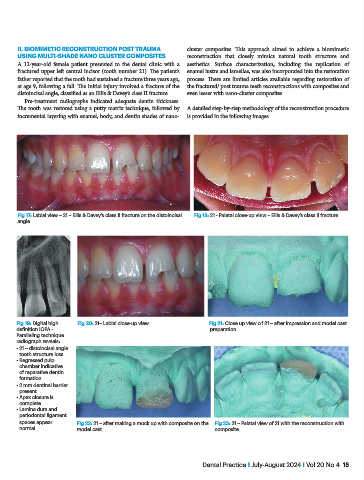
II. BIOMIMETIC RECONSTRUCTION POST TRAUMA              cluster composites. This approach aimed to achieve a biomimetic
           USING MULTI-SHADE NANO CLUSTER COMPOSITES              reconstruction  that  closely mimics  natural  tooth  structure  and
           A 12-year-old female patient presented to the dental clinic with a   aesthetics. Surface  characterization, including the  replication of
           fractured upper left central incisor (tooth number 21). The patient’s   enamel lustre and lamellae, was also incorporated into the restoration
           father reported that the tooth had sustained a fracture three years ago,   process. There are limited articles available regarding restoration of
           at age 9, following a fall. The initial injury involved a fracture of the   the fractured/ post trauma teeth reconstructions with composites and
           distoincisal angle, classified as an Ellis & Davey’s class II fracture.  even lesser with nano-cluster composites.
              Pre-treatment radiographs indicated adequate dentin thickness.
           The tooth was restored using a putty matrix technique, followed by   A detailed step-by-step methodology of the reconstruction procedure
           incremental layering with enamel, body, and dentin shades of nano-  is provided in the following images.


           Fig 17: Labial view – 21 – Ellis & Davey’s class II fracture on the distoincisal   Fig 18: 21 - Palatal close-up view – Ellis & Davey’s class II fracture.
           angle.


           Fig 19: Digital high   Fig 20: 21– Labial close-up view.       Fig 21: Close up view of 21 – after impression and model cast
           definition IOPA -                                              preparation.
           Paralleling technique
           radiograph reveals:
           •  21 – distoincisal angle
            tooth structure loss
           •  Regressed pulp
            chamber indicative
            of reparative dentin
            formation.
           •  2 mm dentinal barrier
            present.
           •  Apex closure is
            complete.
           •  Lamina dura and
            periodontal ligament
            spaces appear      Fig 22: 21 – after making a mock up with composite on the  Fig 23: 21 – Palatal view of 21 with the reconstruction with
            normal.            model cast.                                 composite.


                                                                       Dental Practice I July-August 2024 I Vol 20 No 4  15

