


Page 44 - DP Vol 20 No 4 HR
P. 44
TMJ SECTION


                             EMBRACING CONSERVATIVE


                                APPROACHES: MANAGING


            TEMPOROMANDIBULAR JOINT DISORDERS


                                             Amelia Edmonds and Sidney Lisser


           INTRODUCTION
           Temporomandibular joint disorders (TMDs) are the second most
           common musculoskeletal (MSK) condition resulting in pain and
           disability (NIH, 2018). One of the most common causes of secondary
           tooth pain is myofascial pain with referral (Bender, 2019). As dental
           professionals  you  are  often  the  first  healthcare  provider  that  will
           identify these conditions. In 2020, unfortunately overlooked due to the
           Covid-19 pandemic, the National Academies of Science, Engineering
           and Medicine presented and published a consensus on the priorities
           in care for TMDs. One of their major recommendations was that the
           first line treatment for TMDs should be conservative and reversible
           care. Implementing a stepped care approach highlights the utilization
           of conservative care, proven to be effective for the majority of TMD
           patients.
              A stepped care model recommends the use of lower-risk, non-
           surgical treatments when feasible, before considering invasive options
           in MSK rehabilitation (Rhon et al, 2022) (Figure 1). Conservative care
           should be considered for managing facial pain when red flags and   Disorders (DC-TMD) as a dependable resource and standard to
           odontogenic causes have been ruled out. The first step is a relevant   follow for examination of the orofacial region for the general patient
           clinical assessment and accurate diagnosis followed by appropriate   (Schiffman 2014). Often, we need to look beyond the standard DC-
           and best practices. Misdiagnosis or mismanagement in the initial   TMD exam as patients may have adapted to their injury and present
           stages often steers patients towards unnecessary, invasive procedures,   abnormally. Physical examination should also reference the patients’
           resulting in ineffective care and poor patient outcomes.  activities of daily living and not just what is considered ‘normal’ within
              In appropriate cases, there is a place for more invasive procedures   the DC-TMD guidelines.
           such as injectables, surgeries, or medications; however, it is the primary   Historical findings in a patient that presents with the pain of an
           treatment for a select few. This article will explore MSK diagnosis   MSK origin may include pain with mastication, clicking, locking,
           and  examination, noninvasive  approaches  to treat  TMDs,  and  the   and headaches, to name a few. It is important to use your physical
           challenges hindering accessible conservative care. As we discuss   exam to then narrow down the MSK  diagnosis. When observing
           these topics, it will become evident that the understanding of these   jaw movements, check for asymmetries, limited ranges of motion, or
           components is crucial for advancing effective healthcare for TMDs.  deviations during opening and closing.
                                                                     If you observe limited opening, you must determine if it is the
           MSK DIAGNOSIS & EXAM                                   result of a physical and/or pain barrier, fear of opening, or abnormal
           TMDs should be used as an umbrella term to encapsulate many   opening due to pain (antalgia). After injury, patients are often afraid
           orofacial pain conditions; however, it should not be considered as   to move despite having full range of motion. If there is no acute
           a diagnosis. TMD provides little specificity to the mechanism or   trauma, encouraging movement despite associated pain is crucial in
           pathology of the injury and would not be considered an accurate   rehabilitating them back to normal function. Palpation of the joints
           diagnosis in a stepped care model. Common MSK diagnoses like   and associated  muscles  helps identify  tenderness or  pain, clicking,
           tendinopathy, non-inflammatory arthropathies, or muscle-referred   crepitus,  or  irregularities.  Compressing  joint  surfaces  passively  can
           pain are extendable to the orofacial area.             also identify painful structures within the joint. Remember, your most
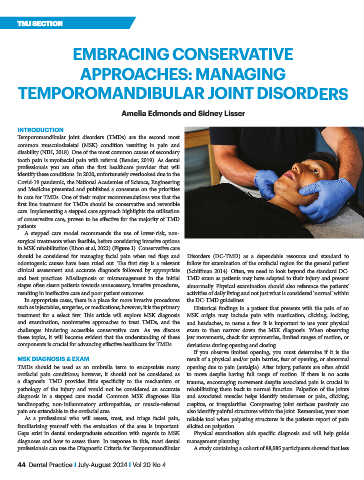
              As a professional who will assess, treat, and triage facial pain,   reliable tool when palpating structures is the patients report of pain
           familiarizing yourself with the evaluation of the area is important.   elicited on palpation.
           Gaps exist in dental undergraduate education with regards to MSK   Physical examination aids specific diagnosis and will help guide
           diagnoses and how to assess them. In response to this, most dental   management planning.
           professionals can use the Diagnostic Criteria for Temporomandibular   A study containing a cohort of 88,985 participants showed that less

           44  Dental Practice I July-August 2024 I Vol 20 No 4

