


Page 40 - DP Vol 20 No 4 HR
P. 40
PEDIATRIC DENTISTRY SECTION


                ADVANCED RESTORATION OF PRIMARY


                       ANTERIOR TEETH WITH CAD/CAM


                          TECHNOLOGY: A CASE REPORT


                                    Joies Susan Varghese, PC Chayanika, Smita Kumari


           INTRODUCTION
           Primary teeth are crucial elements of a child’s dentition, and their
           importance is increasingly recognized. Preserving their functional
           and aesthetic qualities, supporting normal speech development, and
           maintaining adequate space for the eruption of permanent teeth are
           key reasons why primary teeth are treated with utmost care.¹
           CAD/CAM (Computer-Aided Design and Computer-Aided
           Manufacturing) systems have been used in dentistry since the mid-
           1980s and have gained  popularity due to their wide application in
           various fields, including prosthodontics, crown and bridge work,
           implantology, orthodontics, and pediatric dentistry.² This technology
           provides aesthetic restorations that are both durable and precise. The
           exceptional mechanical properties of these materials make CAD/
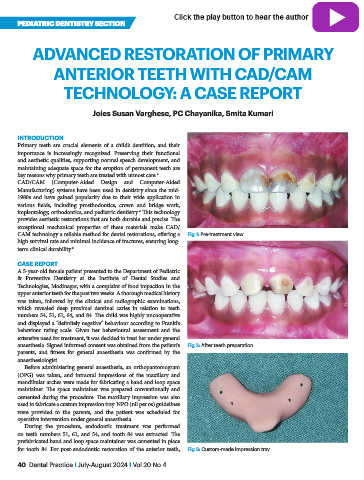
           CAM technology a reliable method for dental restorations, offering a   Fig 1: Pre-treatment view
           high survival rate and minimal incidence of fractures, ensuring long-
           term clinical durability.³

           CASE REPORT
           A 5-year-old female patient presented to the Department of Pediatric
           & Preventive Dentistry at the Institute of Dental Studies and
           Technologies, Modinagar, with a complaint of food impaction in the
           upper anterior teeth for the past two weeks. A thorough medical history
           was taken, followed by the clinical and radiographic examinations,
           which revealed deep proximal dentinal caries in relation to teeth
           numbers 54, 51, 61, 64, and 84. The child was highly uncooperative
           and displayed a “definitely negative” behaviour according to Frankl’s
           behaviour rating scale. Given her behavioural assessment and the
           extensive need for treatment, it was decided to treat her under general
           anaesthesia. Signed informed consent was obtained from the patient’s   Fig 2: After teeth preparation
           parents, and fitness for general anaesthesia was confirmed by the
           anaesthesiologist.
              Before administering general anaesthesia, an orthopantomogram
           (OPG)  was taken, and intraoral  impressions  of the  maxillary and
           mandibular arches were made for fabricating a band and loop space
           maintainer. The space maintainer was prepared conventionally and
           cemented during the procedure. The maxillary impression was also
           used to fabricate a custom impression tray. NPO (nil per os) guidelines
           were provided to the parents, and the patient was scheduled for
           operative intervention under general anaesthesia.
              During the procedure, endodontic  treatment was performed
           on teeth numbers 51, 61, and 54, and tooth 84 was extracted. The
           prefabricated band and loop space maintainer was cemented in place
           for tooth 84. For post-endodontic restoration of the anterior teeth,   Fig 3: Custom-made impression tray

           40  Dental Practice I July-August 2024 I Vol 20 No 4

