


Page 45 - DP Vol 20 No 4 HR
P. 45
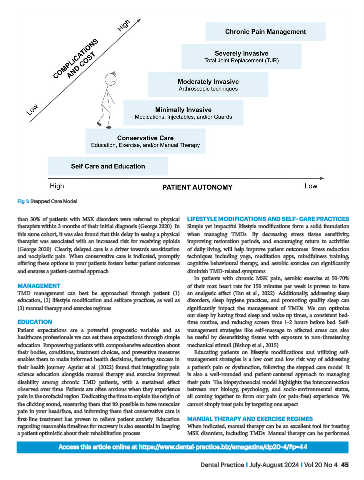
Fig 1: Stepped Care Model


           than 30% of patients with MSK disorders were referred to physical   LIFESTYLE MODIFICATIONS AND SELF- CARE PRACTICES
           therapists within 3 months of their initial diagnosis (George 2020). In   Simple yet impactful lifestyle modifications form a solid foundation
           this same cohort, it was also found that this delay in seeing a physical   when managing TMDs. By decreasing stress tissue sensitivity,
           therapist was associated with an increased risk for receiving opioids   improving restoration periods, and encouraging return to activities
           (George 2020). Clearly, delayed care is a driver towards sensitization   of daily living, will help improve patient outcomes. Stress reduction
           and nociplastic pain. When conservative care is indicated, promptly   techniques including yoga, meditation apps, mindfulness training,
           offering these options to your patients fosters better patient outcomes   cognitive behavioural therapy, and aerobic exercise can significantly
           and ensures a patient-centred approach.                diminish TMD-related symptoms.
                                                                     In patients with chronic MSK pain, aerobic exercise at 50-70%
           MANAGEMENT                                             of their max heart rate for 150 minutes per week is proven to have
           TMD management can best be approached through patient (1)   an analgesic effect (Tan et al., 2022). Additionally, addressing sleep
           education, (2) lifestyle modification and selfcare practices, as well as   disorders, sleep hygiene practices, and promoting quality sleep can
           (3) manual therapy and exercise regimes.               significantly impact the management of TMDs. We can optimize
                                                                  our sleep by having fixed sleep and wake-up times, a consistent bed-
           EDUCATION                                              time routine, and reducing screen time 1-2 hours before bed. Self-
           Patient expectations are a powerful prognostic variable and as   management strategies like self-massage to affected areas can also
           healthcare professionals we can set these expectations through simple   be useful by desensitizing tissues with exposure to non-threatening
           education. Empowering patients with comprehensive education about   mechanical stimuli (Bishop et al., 2015).
           their bodies, conditions, treatment choices, and preventive measures   Educating patients on lifestyle modifications and utilizing self-
           enables them to make informed health decisions, fostering success in   management strategies is a low cost and low risk way of addressing
           their health journey. Aguiar et al. (2022) found that integrating pain   a patient’s pain or dysfunction, following the stepped care model. It
           science education alongside manual therapy and exercise improved   is also a well-rounded and patient-centered approach to managing
           disability among chronic TMD patients, with a sustained effect   their pain. The biopsychosocial model highlights the interconnection
           observed over time. Patients are often anxious when they experience   between our biology, psychology, and socio-environmental status,
           pain in the orofacial region. Dedicating the time to explain the origin of   all coming together to form our pain (or pain-free) experience. We
           the clicking sound, reassuring them that it’s possible to have muscular   cannot simply treat pain by targeting one aspect.
           pain in your head/face, and informing them that conservative care is
           first-line treatment has proven to relieve patient anxiety. Education   MANUAL THERAPY AND EXERCISE REGIMES
           regarding reasonable timelines for recovery is also essential in keeping   When indicated, manual therapy can be an excellent tool for treating
           a patient optimistic about their rehabilitation process.  MSK disorders, including TMDs. Manual therapy can be performed

                         Access this article online at https://www.dental-practice.biz/emagazine/dp20-4/#p=44

                                                                       Dental Practice I July-August 2024 I Vol 20 No 4  45

