


Page 15 - Dental Technology June 2022
P. 15
14-17-Nico article-Q8_6-7-8-Ivoclar.qxd  7/13/2022  9:10 PM  Page 2


                                                                                       laboratory section 15
              DENTAL TECHNOLOGY, APRIL-JUNE 2022


                                                                      Air nd 1,00


                                                     Enamel nd 1,63


                                        DEC nd 1,43


                           Dentin nd 1,54


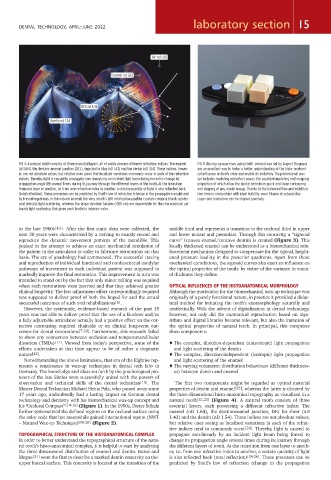
              FIG 4: A natural tooth consists of three essential layers, all of which possess different refractive indices: The enamel  FIG 5: Waxing-up exercises using tooth-colored wax set by August Bruguera
              (nD 1.64), the dentino-enamel junction (DEJ), depicted in blue (nD 1.43) and the dentin (nD 1.54). These indices, howev-  are an excellent way to foster a better understanding of the histo-anatomi-
              er, are not absolute values, but relative ones given that localized variations commonly occur in each of the refractive  cal influence on tooth color and enable its imitation. The professional wax
              indices. Thereby, light is caused to propagate non-linearly by an incident light beam being forced to change its  set includes modeling and effect waxes, the excellent modeling and scraping
              propagation angle (θ) several times during its journey through the different layers of the tooth. At the transition  properties of which allow the dental technician quick and clean contouring
              from one layer to another, i.e. from one refractive index to another, a certain quantity of light is also reflected back  and shaping of any model waxup. Thanks to the balanced flow and solidifica-
              (total reflection). These processes can be predicted by Snell's law of refraction (change in the propagation angle) and  tion time in conjunction with ideal stability, even filigree structures like
              by Fresnel equations. In the natural enamel, the very small (< 260 nm) hydroxyapatite crystals create a bluish, opales-  cusps and mamelons can be shaped precisely.
              cent (elastic) light scattering, whereas the larger dentinal tubules (>780 nm) are responsible for the characteristic yel-
              lowish light scattering that gives each tooth its intrinsic color.


              to the late 1960s [4,5] . After the first static data were collected, the  middle third and represents a transition to the occlusal third in upper
              next 20 years were characterized by a striving to exactly record and  and lower molars and premolars. Through this concavity, a “sigmoid
              reproduce  the  dynamic  movement  patterns  of  the  mandible.  This  curve” (convex enamel/concave dentin) is created (Figure 3). This
              peaked in the attempt to achieve an exact mechanical simulation of  locally thickened enamel can be understood as a biomechanical rein-
              the patient in the articulator in order to fabricate restorations on that  forcement mechanism designed to compensate for the typical, height-
              basis. The era of gnathology had commenced. The successful tracing  ened pressure loading in the posterior quadrants. Apart from these
              and reproduction of individual functional and nonfunctional condylar  mechanical correlations, the sigmoid curves also exert an influence on
              pathways of movement in each individual patient was supposed to  the optical properties of the tooth: by virtue of the variance in enam-
              markedly improve the final restoration. This improvement in turn was  el thickness they define.
              intended to stand out by the fact that only minor milling was required
              when such restorations were inserted and that they achieved greater  OPTICAL INFLUENCES OF THE HISTOANATOMICAL MORPHOLOGY
              clinical longevity. The less adjustment effort correspondingly required  Although the motivation for the biomechanical wax-up technique was
              was supposed to deliver proof of both the hoped-for and the actual  originally of a purely functional nature, in practice it provided a didac-
              successful outcomes of such oral rehabilitations [6] .         tical method for imitating the tooth’s exomorphology naturally and
                However, the systematic, evidence-based research of the past 15  aesthetically. With the advent of digitalization in dental technology,
              years was not able to deliver proof that the use of a facebow and/or  however,  not  only  did  the  anatomical  reproduction  based  on  algo-
              a fully adjustable articulator actually had a positive effect on the cor-  rithms and digital libraries become relevant, but also the imitation of
              rective  contouring  required  chairside  or  on  clinical  long-term  out-  the  optical  properties  of  natural  teeth.  In  principal,  this  comprises
              comes for dental restorations [7-10] . Furthermore, this research failed  three components:
              to show any connection between occlusion and temporomandibular
              disorders (TMDs) [11] . Viewed from today's perspective, some of the  ♦ The complex, direction-dependent (anisotropic) light propagation
              efforts  undertaken  at  that  time  appear  to  be  of  rather  a  dogmatic  and light scattering of the dentin
              nature [12] .                                                  ♦ The  complex,  direction-independent  (isotropic)  light  propagation
                Notwithstanding the above limitations, that era of the Eighties rep-  and light scattering of the enamel
              resents  a  renaissance  in  wax-up  techniques  in  dental  tech  labs  in  ♦ The varying volumetric distribution behaviours (different thickness-
              Germany. The knowledge and ideas set forth by the gnathological pio-  es) between dentin and enamel
              neers of the late Sixties were successfully united with the powers of
              observation  and  technical  skills  of  the  dental  technician [13] .  The  The first two components might be regarded as optical material
              Master Dental Technician Michael Heinz Polz, who passed away some  properties of dentin and enamel [22] , whereas the latter is dictated by
              17 years ago, undoubtedly had a lasting impact on German dental  the three-dimensional histo-anatomical topography as visualized in a
              technology and dentistry with his biomechanical wax-up concept and  natural  tooth [21,23]  (Figure  4).  A  natural  tooth  consists  of  three
              his "Occlusal Compass” [14-15]  (Figure 1). In the 1990s, Dieter Schulz  essential  layers,  each  possessing  a  different  refractive  index:  The
              further systematized the defined regions on the occlusal surface using  enamel  (nD  1.64),  the  dentinoenamel  junction,  DEJ  for  short  (nD
              the color code that has meanwhile gained international repute (NWT  1.43) and the dentin (nD 1.54). These indices are not absolute values,
              – Natural Wax-up Technique) [16-20]  (Figure 2).               but relative ones seeing as localized variations in each of the refrac-
                                                                             tive indices tend to commonly occur [24] . Thereby, light is caused to
              TOPOGRAPHICAL STRUCTURE OF THE HISTOANATOMICAL COMPLEX         propagate  non-linearly  by  an  incident  light  beam  being  forced  to
              In order to better understand the topographical structure of the natu-  change its propagation angle several times during its journey through
              ral tooth’s histo-anatomical complex, it is helpful to start by analysing  the different layers of tooth. At the transition from one layer to anoth-
              the three-dimensional distribution of enamel and dentin. Bazos and  er, i.e. from one refractive index to another, a certain quantity of light
              Magne [21]  were the first to describe a marked dentin concavity on the-  is also reflected back (total reflection) [24-26] . These processes can be
              upper buccal surface. This concavity is located at the transition of the  predicted  by  Snell's  law  of  refraction  (change  in  the  propagation

