


Page 16 - Dental Technology June 2022
P. 16
14-17-Nico article-Q8_6-7-8-Ivoclar.qxd  7/13/2022  9:10 PM  Page 3


              16 laboratory section                                                                 DENTAL TECHNOLOGY, APRIL-JUNE 2022


              angle) and by Fresnel equations. In the nat-  exerts  a  significant  influence  on  the  lumi-
              ural  enamel,  the  very  small  (<  260  nm)  nous  reflectance  (brightness)  of  natural  THE HISTO-ANATOMICAL WAX-UP TECHNIQUE
              hydroxyapatite  crystals  create  a  bluish,  tooth.  Early  studies  by  Kraus [30]  (1952)  Waxing-up exercises using tooth-colored wax
              opalescent (elastic) light scattering whereas  showed  that  the  enamel  at  the  bucco-  are an excellent way to foster a better under-
              the larger dentinal tubules (> 780 nm) [27]  occlusal  surfaces  of  the  first  lower  molars  standing  of  the  histo-anatomical  influence
              are responsible for the characteristic yellow-  demonstrates the largest enamel thickness of  on tooth color while enabling its imitation as
              ish light scattering each of which gives the  all dentition in the jaw (1.8 to 2.2 mm). That  well.  The  professional  wax  set  by  August
              tooth its intrinsic color [28] .          is why – absent all abrasion or erosion phe-  Bruguera allows quick and clean contouring
                In this connection, it is interesting to note  nomena  –  the  lower  first  molar  usually  of  any  wax-up  using  modeling  and  effect
              that  the  literature  often  reports  that  tooth  shows  the  highest  luminance  of  all  teeth.  waxes  that  exhibit  excellent  modeling  and
              color is predominantly dictated by the dentin.  The ratio of coronal configuration to enamel  scraping properties. Thanks to the balanced
              This notion appears to confirm the common  thickness (three components) is particularly  flow and solidification time partnered with
              perception that the translucence from natural  reflected  in  the  most  recent  approaches  an ideal stability, even filigree structures like
              enamel  is  higher  than  from  natural  dentin.  found in digital reproduction [31] . In this con-  cusps and mamelons can be shaped precise-
              Yet such a statement is not entirely true. A  text, the striving is to reproduce such histo-  ly (Figure 5). The goal is not only to imitate
              study by Yu et al [29]  showed that the average  anatomical  restorations  completely  by  the  exomorphology  of  the  posterior  teeth
              translucence of enamel is only slightly higher  mechanical  means.  A  hybridization  of  sub-  based onthe natural model – as is the tradi-
              (approx. 2%) than that of dentin.         tractive (CAD/CAM-supported milling) and  tional convention – but also to reproduce the
                The fact that translucence is a function of  additive (3D printing) fabrication technolo-  internal  endomorphology  of  the  dentin  in
              a tooth’s thickness and that dentin is usually  gy is designed to achieve this [32] . At present,  order to enable a better understanding of the
              thicker  than  enamel  has  frequently  been  to what extent this will actually be feasible in  optical  interaction  of  both  components
              overlooked. As a result, the enamel thickness  the near future still remains uncertain [33] .  (Figures 6 and 7).


                                                                                                  ATLAS OF THE HISTO-ANATOMICAL STUDY OF
                                                                                                  THE UPPER AND LOWER POSTERIOR TEETH
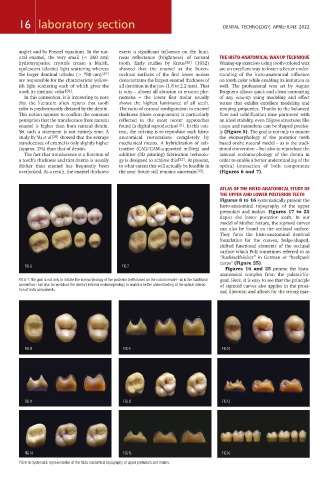
                                                                                                  Figures 8 to 16 systematically present the
                                                                                                  histo-anatomical  topography  of  the  upper
                                                                                                  premolars and molars. Figures 17 to 25
                                                                                                  depict  the  lower  posterior  teeth.  In  our
                                                                                                  model of Mother Nature, the sigmoid curves
                                                                                                  can  also  be  found  on  the  occlusal  surface.
                                                                                                  They  form  the  histo-anatomical  dentinal
                                                                                                  foundation  for  the  convex,  bulge-shaped,
                                                                                                  shifted  functional  elements  of  the  occlusal
                                                                                                  surface which Polz sometimes referred to as
                                                                                                  "Rucksackhöcker”  in  German  or  “backpack
                                                                                                  cusps” (Figure 25).
                FIG 6                                    FIG 7
                                                                                                     Figures  16  and  25 present  the  histo-
                                                                                                  anatomical  complex  from  the  palatal/lin-
              FIG 6-7: The goal is not only to imitate the exomorphology of the posterior teeth based on the natural model – as is the traditional  gual. Here, it is easy to see that the principle
              convention – but also to reproduce the dentin’s internal endomorphology to enable a better understanding of the optical interac-  of sigmoid curves also applies in the proxi-
              tion of both components.
                                                                                                  mal direction and allows for the strong mar-


                FIG 8                                     FIG 9                                    FIG 10


                FIG 11                                    FIG 12                                   FIG 13


                FIG 14                                    FIG 15                                   FIG 16

              FIG 8-16: Systematic representation of the histo-anatomical topography of upper premolars and molars.

