


Page 20 - Dental Technology June 2022
P. 20
20-23-Antonello article-Q8_6-7-8-Ivoclar.qxd  7/13/2022  9:15 PM  Page 1


              20 cosmetic section                                                                   DENTAL TECHNOLOGY, APRIL-JUNE 2022


                           REPRODUCING VIBRANT LIGHT


              DYNAMICS WITH VENEERING CERAMIC


                                        ANTONELLO MARIA MESSINA AND MICHELE PROSPERINO


              “Everything should be made as simple as possible, but no simpler,”
              claimed  world-renowned  physicist  and  Nobel  Prize  laureate  Albert
              Einstein.
                The same is true of ceramic reproduction. Layering should be as
              simple and efficient as possible, so that it doesn’t seem too fussy or arti-
              ficial. However, simplicity also has its limits if you want to reproduce
              the complexity of nature in a highly esthetic way. Veneers fabricated on
              fireproof dies using veneering ceramic must harmonize in the narrow-
              est of spaces with the underlying enamel and dentin, and at the same
              time reproduce the individual nuances and effects of the patient’s den-
              tition that are consistent with the impression of the natural hard tooth
              substance.
                To achieve harmony, the remaining shade effect of the tooth – the
              precisely determined basic tooth shade – should be confirmed and sup-
              ported as simply as possible. For enamel layering, creativity and a lit-
              tle more complexity are required in order to use targeted refraction,
              reflection, absorption and transmission of light to reproduce a multi-
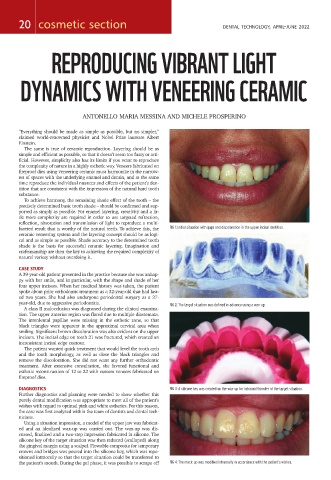
              faceted result that is worthy of the natural teeth. To achieve this, the  FIG 1: Initial situation with gaps and discoloration in the upper incisal dentition.
              ceramic veneering system and the layering concept should be as logi-
              cal and as simple as possible. Shade accuracy to the determined tooth
              shade  is  the  basis  for  successful  ceramic  layering.  Imagination  and
              craftsmanship are then the key to achieving the required complexity of
              natural variety without overdoing it.

              CASE STUDY
              A 39-year-old patient presented in the practice because she was unhap-
              py with her smile, and in particular, with the shape and shade of her
              four upper incisors. When her medical history was taken, the patient
              spoke about prior orthodontic treatment as a 32-year-old that had last-
              ed two years. She had also undergone periodontal surgery as a 37-
              year-old, due to aggressive periodontitis.                     FIG 2: The target situation was defined in advance using a wax-up.
                A class II malocclusion was diagnosed during the clinical examina-
              tion. The upper anterior region was flared due to multiple diastemata.
              The  interdental  papillae  were  missing  in  the  esthetic  zone,  so  that
              black triangles were apparent in the approximal cervical area when
              smiling. Significant brown discoloration was also evident on the upper
              incisors. The incisal edge on tooth 21 was fractured, which created an
              inconsistent incisal edge contour.
                The patient wanted quick treatment that would level the tooth arch
              and  the  tooth  morphology,  as  well  as  close  the  black  triangles  and
              remove the discoloration. She did not want any further orthodontic
              treatment.  After  extensive  consultation,  she  favored  functional  and
              esthetic reconstruction of 12 to 22 with custom veneers fabricated on
              fireproof dies.
              DIAGNOSTICS                                                    FIG 3: A silicone key was created on the wax-up for intraoral transfer of the target situation.
              Further diagnostics and planning were needed to show whether this
              purely dental modification was appropriate to meet all of the patient’s
              wishes with regard to optimal pink and white esthetics. For this reason,
              the case was first analyzed within the team of dentists and dental tech-
              nicians.
                Using a situation impression, a model of the upper jaw was fabricat-
              ed  and  an  idealized  wax-up  was  carried  out.  The  wax-up  was  dis-
              cussed, finalized and a two-step impression fabricated in silicone. The
              silicone key of the target situation was then reduced (scalloped) along
              the gingival margin using a scalpel. Flowable composite for temporary
              crowns and bridges was poured into the silicone key, which was repo-
              sitioned intraorally so that the target situation could be transferred to
              the patient’s mouth. During the gel phase, it was possible to scrape off  FIG 4: The mock-up was modified intraorally in accordance with the patient’s wishes.

