


Page 21 - Dental Technology 12-3
P. 21
20-22-Thomas Lee article-Q8_6-7-8-Ivoclar.qxd  10/6/2022  8:47 PM  Page 2


                                                                               prosthodontic section 21
              DENTAL TECHNOLOGY, JULY-SEPTEMBER 2022


              FIG 5                                       FIG 6                                          FIG 7


              FIG 8                                   FIG 9                                  FIG 10

                                                                             clusal record usually incorporates the use of an anterior discluder
              STEP 3 OPTION
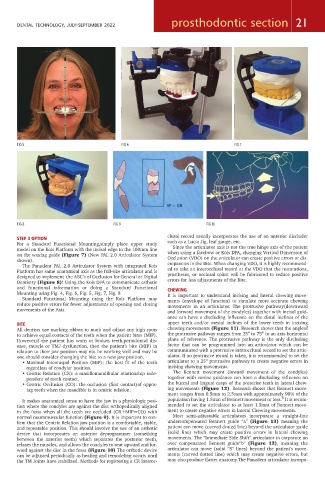
              For  a  Standard  Functional  Mounting,simply  place  upper  study  such as a Lucia Jig, leaf gauge, etc.
                                                                               Since the articulator axis is not the true hinge axis of the patient
              model on the Kois Platform with the incisal edge to the 100mm line
              on the waxing guide (Figure 7) (New PAL 2.0 Articulator System  when using a facebow or Kois DFA, changing Vertical Dimension of
              shown).                                                        Occlusion (VDO) on the articulator can create positive errors or dis-
                The  Panadent  PAL  2.0  Articulator  System  with  integrated  Kois  crepancies in the Bite. When changing VDO, it is highly recommend-
                                                                             ed to take an interocclusal record at the VDO that the restorations,
              Platform has same anatomical axis as the full-size articulator and is
              designed to implement  the ABC’s of Occlusion for General or Digital  prostheses, or occlusal splint will be fabricated to reduce positive
              Dentistry (Figure 8)! Using the Kois DFA to communicate esthetic  errors for less adjustments of the Bite.
              and  functional  information  or  doing  a  Standard  Functional
                                                                             CHEWING
              Mounting using Fig. 4, Fig. 6, Fig. 5, Fig. 7, Fig. 8          It  is  important  to  understand  incising  and  lateral  chewing  move-
                Standard  Functional  Mounting  using  the  Kois  Platform  may  ments  (envelope  of  function)  to  simulate  more  accurate  chewing
              reduce positive errors for fewer adjustments of opening and closing  movements  in  an  articulator.  The  protrusive  pathway(downward
              movements of the Axis.
                                                                             and forward movement of the condyles) together with incisal guid-
                                                                             ance can have a discluding influence on the distal inclines of the
              BITE                                                           upper  teeth  and/or  mesial  inclines  of  the  lower  teeth  in  incising
              All dentists use marking ribbon to mark and adjust any high spots  chewing movements (Figure 11). Research shows that the angleof
                                                                                                                     o
                                                                                                               o
              to achieve equal contacts of the teeth when the patient bites (MIP).  the protrusive pathway ranges from 25 to 75 to an axis-horizontal
              However,if  the  patient  has  worn  or  broken  teeth,periodontal  dis-  plane of reference. The protrusive pathway is the only discluding
              ease, muscle or TMJ dysfunction, then the patient’s bite (MIP) in  factor  that  can  be  programmed  into  an  articulator  which  can  be
              relation to their jaw position may not be working well and may be  communicated with a protrusive interocclusal record to set the artic-
              one should consider changing the bite to a new jaw position.   ulator. If no protrusive record is taken, it is recommended to set the
                                                                                             o
                • Maximal  Intercuspal  Position  (MIP):  the  best  fit  of  the  teeth  articulator to a 25 protrusive pathway to create negative errors in
                  regardless of condylar position.                           incising chewing movements.
                • Centric Relation (CR): a maxillomandibular relationship inde-  The  Bennett  movement  (inward  movement  of  the  condyles)
                  pendent of tooth contact.                                  together with canine guidance can have a discluding influence on
                • Centric Occlusion (CO): the occlusion (first contact)of oppos-  the buccal and lingual cusps of the posterior teeth in lateral chew-
                  ing teeth when the mandible is in centric relation.        ing movements (Figure 12). Research shows that Bennett move-
                                                                             ment ranges from 0.5mm to 2.5mm with approximately 90% of the
                                                                                                                             8
                It makes anatomical sense to have the jaw in a physiologic posi-  population having 1.5mm of Bennett movement or less. It is recom-
              tion where the condyles are against the disc orthopedically aligned  mended to set the articulator to at least 1.5mm of Bennett move-
              in the fossa when all the teeth are occluded (CR+MIP=CO) with  ment to create negative errors in lateral Chewing movements.
              normal neuromuscular function (Figure 9). It is important to con-  Most  semi-adjustable  articulators  incorporate  a  straight-line
              firm that the Centric Relation jaw position is a comfortable, stable,  undercompensated  Bennett  guide  “a”  (Figure  13) meaning  the
              and repeatable position. This should involve the use of an orthotic  patient can move (curved dotted line) beyond the articulator guide
              device  that  incorporates  an  anterior  deprogrammer  (something  (solid  line)  which  may  create  positive  errors  in  lateral  chewing
              between  the  anterior  teeth)  which  separates  the  posterior  teeth,  movements. The “Immediate Side Shift” articulator in corporate an
              relaxes the muscles, and allows the condyles to seat upward and for-  over  compensated  Bennett  guide“b”  (Figure  13),  meaning  the
              ward against the disc in the fossa (Figure 10) The orthotic device  articulator  can  move  (solid  “S”  lines)  beyond  the  patient’s  move-
              can be adjusted periodically as healing and remodeling occurs until  ments (curved dotted line) which may create negative errors, but
              the TM Joints have stabilized. Methods for registering a CR interoc-  may also produce flatter anatomy.The Panadent articulator incorpo-

