


Page 22 - Dental Technology 12-3
P. 22
20-22-Thomas Lee article-Q8_6-7-8-Ivoclar.qxd  10/6/2022  8:48 PM  Page 3


              22 prosthodontic section                                                         DENTAL TECHNOLOGY, JULY-SEPTEMBER 2022


              FIG 11                                                         FIG 12

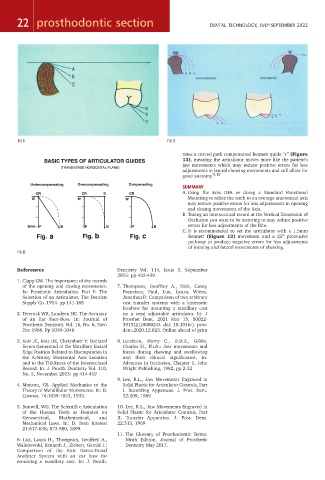
                                                                                   rates a curved path compensated Bennett guide “c” (Figure
                                                                                   13), meaning the articulator moves more like the patient’s
                                                                                   jaw  movements  which  may  reduce  positive  errors  for  less
                                                                                   adjustments in lateral chewing movements and still allow for
                                                                                   good anatomy. 9,10

                                                                                   SUMMARY
                                                                                   A.Using  the  Kois  DFA  or  doing  a  Standard  Functional
                                                                                     Mounting to relate the teeth to an average anatomical axis
                                                                                     may reduce positive errors for less adjustments in opening
                                                                                     and closing movements of the Axis.
                                                                                   B. Taking an interocclusal record at the Vertical Dimension of
                                                                                      Occlusion you want to be restoring to may reduce positive
                                                                                      errors for less adjustments of the Bite.
                                                                                   C. It  is  recommended  to  set  the  articulator  with  a  1.5mm
                                                                                                                             o
                                                                                      Bennett  (Figure  13) movement  and  a  25 protrusive
                                                                                      pathway to produce negative errors for less adjustments
                                                                                      of incising and lateral movements of chewing.
              FIG 13


              References                                Dentistry  Vol.  114,  Issue  3,  September
                                                        2015: pp 432-439
              1. Clapp GW. The importance of the records
                of the opening and closing movements.   7. Thompson,  Geoffrey  A.,  Nick,  Casey,
                In:  Prosthetic  Articulation.  Part  V-  The  Francisco,  Paul,  Lux,  Laura,  Wiens,
                Selection of an Articulator, The Dentists  Jonathan P.: Comparison of two arbitrary
                Supply Co. 1914. pp 141-165               cast  transfer  systems  with  a  kinematic
                                                          facebow  for  mounting  a  maxillary  cast
              2. Teteruck WR, Lundeen HC. The Accuracy    on  a  semi  adjustable  articulator.  In:  J
                of  an  Ear  Face-Bow.  In:  Journal  of  Prosthet  Dent.  2021  Mar  15;  S0022-
                Prosthetic Dentistry. Vol. 16, No. 6, Nov-  3913(21)00002-0. doi: 10.1016/j. pros-
                Dec 1966. Pp 1039-1046                    dent.2020.12.023. Online ahead of print
              3. Kois JC, Kois DE, Chaiyabutr Y: Occlusal  8. Lundeen,  Harry  C.,  D.D.S.,  Gibbs,
                Errors Generated at the Maxillary Incisal  Charles  H.,  Ph.D.:  Jaw  movements  and
                Edge Position Related to Discrepancies in  forces  during  chewing  and  swallowing
                the  Arbitrary  Horizontal  Axis  Location  and  their  clinical  significance,  In:
                and to the Thickness of the Interocclusal  Advances in Occlusion, Chapter 1, John
                Record. In: J. Prosth. Dentistry Vol. 110,  Wright Publishing, 1982, pp 2-32
                No. 5, November 2013: pp 414-419
                                                        9. Lee,  R.L.,  Jaw  Movements  Engraved  in
              4. Monson,  GS.  Applied  Mechanics  to  the  Solid Plastic for Articulator Controls, Part
                Theory of Mandibular Movements. In: D.    I.  Recording  Apparatus.  J.  Pros.  Dent.
                Cosmos. 74:1039-1053, 1932.               22:209, 1969

              5. Bonwill, WG. The Scientifi c Articulation  10. Lee, R.L., Jaw Movements Engraved in
                of  the  Human  Teeth  as  Founded  on  Solid  Plastic  for  Articulator  Controls,  Part
                Geometrical,   Mathematical,    and     II.  Transfer  Apparatus.  J.  Pros.  Dent.
                Mechanical  Laws.  In:  D.  Item  Interest  22:513, 1969
                21:617-636; 873-880, 1899.
                                                        11. The  Glossary  of  Prosthodontic  Terms:
              6.  Lux,  Laura  H.,  Thompson,  Geoffrey  A.,  Ninth  Edition.  Journal  of  Prosthetic
              Waliszewski, Kenneth J., Ziebert, Gerald J.:  Dentistry May 2017.
              Comparison  of  the  Kois  Dento-Facial
              Analyzer  System  with  an  ear  bow  for
              mounting  a  maxillary  cast.  In:  J.  Prosth.

