


Page 14 - DT14-1
P. 14
14-20-Mohit-Q8_6-7-8-Ivoclar.qxd  4/15/2024  8:01 PM  Page 1


               14 prosthetic section                                                          DENTAL TECHNOLOGY, JANUARY-MARCH 2024


                               A MINIMALLY INVASIVE APPROACH IN


                        REHABILITATION OF SEVERE EROSION WITH


                  COMPOSITE AND LITHIUM DI-SILICATE MATERIAL


                                          PAVAN KISHORE NALLAPATI AND MOHIT SURYAVANSHI


              CASE PRESENTATION
              A 36-year-old female patient presented to our clinic with complaints of
              tooth  sensitivity  and  difficulty  in  chewing,  accompanied  by  concerns
              regarding low self-esteem due to a compromised smile and impaired chew-
              ing function.
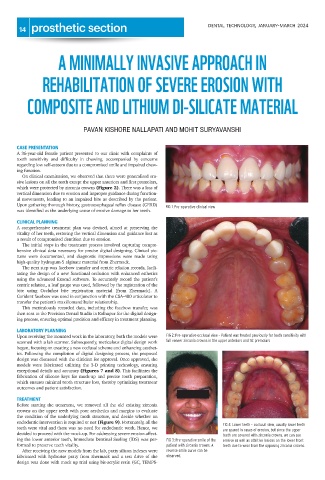
                On clinical examination, we observed that there were generalised ero-
              sive lesions on all the teeth except the upper anteriors and first premolars,
              which were protected by zirconia crowns (Figure 2). There was a loss of
              vertical dimension due to erosion and improper guidance during function-
              al movements, leading to an impaired bite as described by the patient.
              Upon gathering thorough history, gastroesophageal reflux disease (GERD)  FIG 1: Pre-operative clinical view
              was identified as the underlying cause of erosive damage to her teeth.

              CLINICAL PLANNING
              A  comprehensive  treatment  plan  was  devised,  aimed  at  preserving  the
              vitality of her teeth, restoring the vertical dimension and guidance lost as
              a result of compromised dentition due to erosion.
                The initial steps in the treatment process involved capturing compre-
              hensive clinical data necessary for precise digital designing. Clinical pic-
              tures  were  documented,  and  diagnostic  impressions  were  made  using
              high-quality hydrogum-5 alginate material from Zhermack.
                The next step was facebow transfer and centric relation records, facili-
              tating the design of a new functional occlusion with enhanced esthetics
              using  the  advanced  Exocad  software.  To  accurately  record  the  patient’s
              centric relation, a leaf gauge was used, followed by the registration of the
              bite  using  Occlufast  bite  registration  material  [from  Zhermack].  A
              Corident facebow was used in conjunction with the CSA-400 articulator to
              transfer the patient’s maxillomandibular relationship.
                This meticulously recorded data, including the facebow transfer, was
              then sent to the Precision Dental Studio in Kolhapur for the digital design-
              ing process, ensuring optimal precision and efficacy in treatment planning.

              LABORATORY PLANNING
              Upon receiving the mounted work in the laboratory, both the models were  FIG 2: Pre-operative occlusal view – Patient was treated previously for teeth sensitivity with
                                                                            full veneer zirconia crowns in the upper anteriors and 1st premolars
              scanned with a lab scanner. Subsequently, meticulous digital design work
              began, focusing on creating a new occlusal scheme and enhancing aesthet-
              ics. Following the completion of digital designing process, the proposed
              design was discussed with the clinician for approval. Once approved, the
              models  were  fabricated  utilizing  the  3-D  printing  technology,  ensuring
              exceptional details and accuracy (Figures 7 and 8). This facilitates the
              fabrication  of  silicone  keys  for  mock-up  and  precise  tooth  preparation,
              which ensures minimal tooth structure loss, thereby optimizing treatment
              outcomes and patient satisfaction.

              TREATMENT
              Before  starting  the  treatment,  we  removed  all  the  old  existing  zirconia
              crowns on the upper teeth with poor aesthetics and margins to evaluate
              the condition of the underlying tooth structure, and decide whether an
              endodontic intervention is required or not (Figure 9). Fortunately, all the
                                                                                                    FIG 4: Lower teeth - occlusal view, usually lower teeth
              teeth were vital and there was no need for endodontic work. Hence, we                 are spared in cases of erosion, but since the upper
              decided to proceed with the mock-up. For addressing severe erosion affect-            teeth are covered with zirconia crowns, we can see
              ing the lower anterior teeth, Immediate Dentinal Sealing (IDS) was per-  FIG 3: Pre-operative smile of the  erosive as well as attritive lesions on the lower front
              formed to preserve teeth vitality.                            patient with zirconia crowns. A  teeth due to wear from the opposing zirconia crowns.
                After receiving the new models from the lab, putty silicon indexes were  reverse smile curve can be
              fabricated  with  hydrorise  putty  from  zhermack  and  a  test  drive  of  the  observed.
              design was done with mock up trial using bis-acrylic resin (GC, TEMPS-

