


Page 20 - DT14-1
P. 20
14-20-Mohit-Q8_6-7-8-Ivoclar.qxd  4/15/2024  8:03 PM  Page 7


               20 prosthetic section                                                          DENTAL TECHNOLOGY, JANUARY-MARCH 2024


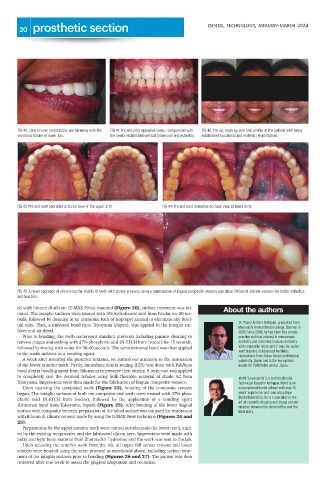
              FIG 40: Lateral view: restorations are harmony with the  FIG 41: Pre and post operative views : comparison with  FIG 42: Pre-op, mock up and final profile of the patient with newly
              vermilion border of lower lips.        the newly established vertical dimension and esthetics  established functional and esthetic rehabilitation.


              FIG 43: Pre and post operative occlusal view of the upper arch   FIG 44: Pre and post operative occlusal view of lower arch


              FIG 45: A novel approach of preserving the vitality of teeth with severe erosions using a combination of lingual composite veneers and labial lithium di-silicate veneers for better esthetics
              and function.


              ed with lithium di-silicate (E-MAX Press) material (Figure 20), surface treatment was ini-  About the authors
              tiated. The intaglio surfaces were treated with 5% hydrofluoric acid from Ivoclar for 20 sec-
              onds, followed by cleaning in an ultrasonic bath of isopropyl alcohol to eliminate any resid-
                                                                                                           Dr. Pavan Kishore Nallapati, graduated from
              ual salts. Then, a universal bond from Tokuyama (Japan), was applied to the intaglio sur-
                                                                                                           Meenakshi Ammal Dental college, Chennai in
              faces and air dried.                                                                         2004. Since 2006, he has been into private
                Prior to bonding, the teeth underwent standard protocols including pumice cleaning to      practice with key interest in microscopic
              remove plaque and etching with 37% phosphoric acid (N-ETCH from Ivoclar) for 15 seconds,     dentistry and minimally invasive dentistry
              followed by rinsing with water for 30-40 seconds. The same universal bond was then applied   with composite resins and E-max. He under-
                                                                                                           went training in Advanced Aesthetic
              to the tooth surfaces as a bonding agent.
                                                                                                           restorations from Tokyo Dental and Medical
                A week after restoring the posterior sextants, we turned our attention to the restoration  university, Japan and is the key opinion
              of the lower anterior teeth. Firstly, immediate dentin sealing (IDS) was done with Palifique  leader for TOKUYAMA dental, Japan.
              bond dentin bonding agent from Tokuyama to preserve their vitality. A resin coat was applied
              to  completely  seal  the  dentinal  tubules  using  bulk  flowable  material  of  shade  A2  from  Mohit Suryavanshi is a certified Dental
              Tokuyama. Impressions were then made for the fabrication of lingual composite veneers.       Technician based in Kolhapur. Mohit is an
                Upon  receiving  the  completed  work  (Figure  22),  bonding  of  the  composite  veneers  accomplished dental artisan with over 25
              began. The intaglio surfaces of both the composite and teeth were treated with 37% phos-     years’ experience and runs a boutique
                                                                                                           Dental laboratory. He is a specialist in the
              phoric  acid  (N-ETCH  from  Ivoclar),  followed  by  the  application  of  a  bonding  agent
                                                                                                           art of cosmetic imaging and image commu-
              (Universal bond from Tokuyama, Japan) (Figure 23). After bonding of the lower lingual        nication between the dental office and the
              surface with composite veneers, preparation of the labial surface was initiated for restoration  laboratory.
              with lithium di-silicate veneers made by using the E-MAX Press technique (Figures 24 and
              25).
                Preparations for the upper anterior teeth were carried out alongside the lower teeth, guid-
              ed by the existing temporaries and the fabricated silicon keys. Impressions were made with
              putty and light body material from Zhermack’s Hydrorise, and the work was sent to the lab.
                Upon receiving the anterior work from the lab, all upper full veneer crowns and lower
              veneers were bonded using the same protocol as mentioned above, including surface treat-
              ment of the intaglio surfaces prior to bonding (Figures 26 and 27). The patient was then
              reviewed after one week to assess the gingival adaptation and occlusion.

