


Page 24 - DT14-1
P. 24
24-27-KLINGNER article-Q8_6-7-8-Ivoclar.qxd  4/15/2024  8:36 PM  Page 1


               24 prosthetic section                                                          DENTAL TECHNOLOGY, JANUARY-MARCH 2024


              DIGITAL COMPLETE DENTURES: A REAL ALTERNATIVE


                      DIGITAL MOUNTING OF COMPLETE DENTURES WITH MILLED BASE AND ARCHES


                                                     ODT. MASTER MATTHIAS KLINGNER


              “It  would  be  nice  to  combine  Zebris  for  FIG 1                               FIG 2
              Ceramill,  i.e.  face  bow  and  centric  and  M-
              Smile  and  FDS.  As  soon  as  this  crossed  my
              mind,  I  said  to  myself:  “Why  shouldn't  it
              work?”  Thus,  was  born  the  idea  of  our  first
              patient  treatment,  which  combines  Ceramill
              FDS, Zebris, M-Smile and Ivotion.


              INITIAL SITUATION
              The patient has been a full prosthesis wearer
              for 36 years. The state of his prosthesis was,
              according to all of today’s standards, insuffi-
              cient, in so far as aesthetics, vertical dimen-
              sion, occlusion and retention.             FIG 3                                    FIG 4

              PREPARATION
              As usual, we took an anatomical impression of
              both  ridges  and  an  in-situ  impression  of  the
              old prostheses. In so doing, we have produced
              the models in the traditional way and scanned
              them with the Ceramill Map600.
              TRAY DESIGN
              To  build  the  functional  impression  trays,  we
              designed  the  case  as  a  bite  in  the  Ceramill
              database.
                                                         FIG 5                                    FIG 6
                The base of the impression tray was there-
              fore designed more or less like a bite: elimi-
              nate  the  undercuts  on  the  model,  mark  the
              extension of the edges and shape them. Next
              – the wax wall.
                This served as a handle, cheek and lip rest
              for fixing the face bow (Zebris) and for a pre-
              registration. For this purpose, we have created
              different building elements, valleys of differ-
              ent upper and lower wax forms and a virtual
              Rim former.
                We  uploaded  this  as  Generic  mash  and
              aligned it with the upper model which served
                                                         FIG 7                                    FIG 8
              as an auxiliary plane for aligning the wax rim.
              Then  we  printed  functional  trays  in  the
              Nextdent 5100, elaborated them and adapted
              a matching tray for the Zebris to simultane-
              ously record the facebow during the function-
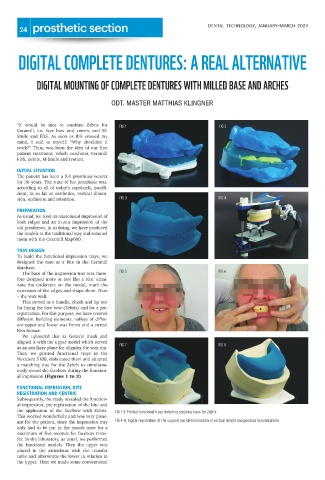
              al impression (Figures 1 to 3)
              FUNCTIONAL IMPRESSION, BITE
              REGISTRATION AND CENTRIC
              Subsequently, the study revealed the function-
              al impression, pre-registration of the bite and
              the  application  of  the  facebow  with  Zebris.  FIG 1-3: Printed functional trays including coupling trays for Zebris
              This worked wonderfully and was very pleas-
              ant for the patient, since the impression tray  FIG 4-8: Digital registration of the support pin (determination of vertical height and position horizontal bite
              only had to be put in the mouth once for a
              maximum of five seconds for facebow trans-
              fer. In the laboratory, as usual, we performed
              the  functional  models.  Then  the  upper  was
              placed  in  the  articulator  with  the  transfer
              table and afterwards the lower in relation to
              the upper. Then we made some conventional

