


Page 26 - DT 15-1
P. 26
26-29-Prandtner_6-7-8-Ivoclar.qxd  01-05-2025  07:45  Page 1


               26 implantology section                                                        DENTAL TECHNOLOGY, JANUARY-MARCH 2025


                      SUCCESS FACTOR OF IMPLANT RESTORATION:


                   THE CONCEPT OF CUSTOMIZED TISSUE SUPPORT


                         OTTO PRANDTNER, DANIEL EDELHOFF, MICHAEL C. BERTHOLD, REZA SAEIDI POUR


              From the patient's perspective, the success of an implant restoration is eval-
              uated based on the appearance of the crown and, especially, the harmonious
              development of peri-implant soft tissues and the natural transition of color
              from the white to the red zone [1] . A natural clinical aspect of an implant
              restoration in the anterior region can be achieved predictably through digi-
              tal pre-planning during the procedure, using the concept of customized tis-
              sue support.
                The use of an immediate provisional prosthesis that reflects the submu-
              cosal contours of the extracted tooth at the time of implant placement is the
              basis  for  promoting  healing  of  peri-implant  soft  tissues.  An  individual
              anatomically shaped gingival retractor or provisional implant crown serves
              as a soft tissue wound closure during immediate implant placement. Both
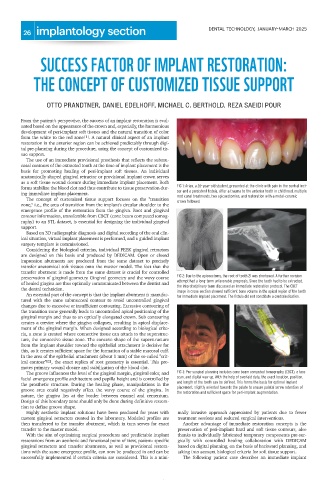
                                                                                FIG 1: Arian, a 26-year-old student, presented at the clinic with pain in the central inci-
              forms stabilize the blood clot and thus contribute to tissue preservation dur-
                                                                                sor and a persistent fistula. After a trauma to the anterior tooth in childhood, multiple
              ing immediate implant placement.
                                                                                root canal treatments, two apicoectomies, and restoration with a metal-ceramic
                The  concept  of  customized  tissue  support  focuses  on  the  "transition
                                                                                crown followed.
              zone," i.e., the area of transition from the implant's circular shoulder to the
              emergence profile of the restoration from the gingiva. Root and gingival
              contour information, transferable from CBCT (cone beam computed tomog-
              raphy) to an STL dataset, is essential for designing the individual gingival
              support.
                Based on 3D radiographic diagnosis and digital recording of the oral clin-
              ical situation, virtual implant placement is performed, and a guided implant
              surgery template is commissioned.
                Considering the biological criterias, individual PEEK gingival retractors
              are  designed  on  this  basis  and  produced  by  DEDICAM.  Open  or  closed
              impression  abutments  are  produced  from  the  same  dataset  to  precisely
              transfer anatomical soft tissues onto the master model. The fact that the
              transfer abutment is made from the same dataset is crucial for controlled
                                                                                FIG 2: Due to the apicoectomy, the root of tooth 21 was shortened. A further revision
              preservation of gingival geometry. Gingival geometry and the wavy course
                                                                                attempt had a long-term unfavorable prognosis. Since the tooth had to be extracted,
              of healed gingiva are thus optimally communicated between the dentist and
                                                                                the interdisciplinary team discussed an immediate restoration protocol. The CBCT
              the dental technician.
                                                                                image in cross-section showed sufficient bone volume in the apical region of the tooth
                An essential part of the concept is that the implant abutment is manufac-  for immediate implant placement. The fistula did not constitute a contraindication.
              tured  with  the  same  submucosal  contour  to  avoid  uncontrolled  gingival
              changes due to excessive or insufficient contouring. Excessive contouring of
              the transition zone generally leads to uncontrolled apical positioning of the
              gingival margin and thus to an optically elongated crown. Sub contouring
              creates a crevice where the gingiva collapses, resulting in apical displace-
              ment of the gingival margin. When designed according to biological crite-
              ria, a zone is created where connective tissue can attach to the superstruc-
              ture, the connective tissue zone. The concave shape of the superstructure
              from the implant shoulder toward the epithelial attachment is decisive for
              this, as it creates sufficient space for the formation of a stable mucosal cuff.
              In the area of the epithelial attachment (about 1 mm) of the so-called "crit-
              ical contour" [2] , the exact replica of root geometry is essential. This pro-
              motes primary wound closure and stabilization of the blood clot.
                The groove influences the level of the gingival margin, gingival color, and  FIG 3: Pre-surgical planning includes cone beam computed tomography (CBCT), a face
                                                                                scan, and digital wax-up. With the help of overlaid data, the exact location, position,
              facial emergence profile architecture and papilla height and is controlled by
                                                                                and length of the tooth can be defined. This forms the basis for optimal implant
              the  prosthetic  structure.  During  the  healing  phase,  manipulations  in  the
                                                                                placement, slightly oriented towards the palate to ensure palatal screw retention of
              groove  area  could  negatively  affect  the  wavy  course  of  the  gingiva.  In
                                                                                the restoration and sufficient space for peri-implant augmentation.
              nature,  the  gingiva  lies  at  the  border  between  enamel  and  cementum.
              Design of this boundary zone should only be done during definitive restora-
              tion to define groove shape.
                Highly aesthetic implant solutions have been produced for years with  mally  invasive  approach  appreciated  by  patients  due  to  fewer
              custom gingival retractors created in the laboratory. Modeled profiles are  treatment sessions and reduced surgical interventions.
              then transferred to the transfer abutment, which in turn serves for exact  Another  advantage  of  immediate  restoration  concepts  is  the
              transfer to the master model.                                      preservation of peri-implant hard and soft tissue contours, also
                With the aim of optimizing surgical procedures and predictable implant  thanks to individually fabricated temporary components pre-sur-
              restorations from an aesthetic and functional point of view, patient- specific  gically  with  controlled  healing  collaboration  with  DEDICAM
              gingival retractors and transfer abutments, as well as provisional restora-  based on digital planning, on the basis of backward planning, and
              tions with the same emergence profile, can now be produced in and can be  taking into account biological criteria for soft tissue support.
              successfully implemented if certain criteria are considered. This is a mini-  The  following  patient  case  describes  an  immediate  implant

