


Page 27 - DT 15-1
P. 27
26-29-Prandtner_6-7-8-Ivoclar.qxd  01-05-2025  07:45  Page 2


              DENTAL TECHNOLOGY, JANUARY-MARCH 2025
                                                                                 implantology section  27


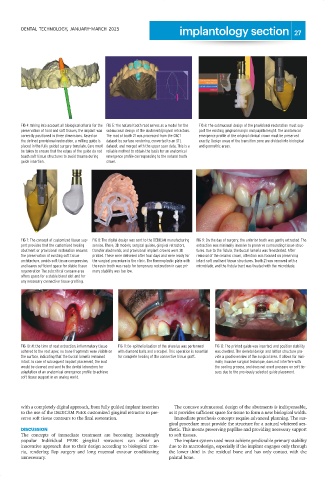
              FIG 4: Taking into account all biological criteria for the FIG 5: The natural tooth root serves as a model for the  FIG 6: The submucosal design of the provisional restoration must sup-
              preservation of hard and soft tissues, the implant was submucosal design of the abutment/gingival retractors.  port the existing gingival margin and papilla height. The anatomical
              correctly positioned in three dimensions. Based on  The root of tooth 21 was processed from the CBCT  emergence profile of the original clinical crown must be preserved
              the defined provisional restoration, a milling guide is  dataset by surface rendering, converted to an STL  exactly. Design areas of the transition zone are divided into biological
              placed in the fully guided surgery template. Care must dataset, and merged with the upper scan data. This is a  and geometric areas.
              be taken to ensure that the edges of the guide do not  reliable method to obtain the basis for an anatomical
              touch soft tissue structures to avoid trauma during  emergence profile corresponding to the natural tooth
              guide insertion.                    crown.


              FIG 7: The concept of customized tissue sup-  FIG 8: The digital design was sent to the DEDICAM manufacturing  FIG 9: On the day of surgery, the anterior tooth was gently extracted. The
              port provides that the customized healing  service. There, 3D models, surgical guides, gingival retractors,  extraction was minimally invasive to preserve surrounding tissue struc-
              abutment or provisional restoration ensures  transfer abutments, and provisional implant crowns were 3D  tures. Due to the fistula, the buccal lamella was fenestrated. After
              the preservation of existing soft tissue  printed. These were delivered after four days and were ready for  removal of the ceramic crown, attention was focused on preserving
              architecture, avoids soft tissue compression,  the surgical procedure in the clinic. The thermoplastic plate with  intact soft and hard tissue structures. Tooth 21 was removed with a
              and leaves sufficient space for stable tissue  the resin tooth was ready for temporary restoration in case pri-  microblade, and the fistula tract was treated with the microblade.
              regeneration The subcritical concave area  mary stability was too low.
              offers space for a stable blood clot and for
              any necessary connective tissue grafting.


              FIG 10: At the time of root extraction, inflammatory tissue  FIG 11: De-epithelialization of the alveolus was performed  FIG 12: The printed guide was inserted, and position stability
              adhered to the root apex; no bone fragments were visible on  with diamond balls and a scalpel. This operation is essential  was checked. The skeletal design and lattice structure pro-
              the surface, indicating that the buccal lamella remained  for complete healing of the connective tissue graft.  vide a good overview of the surgical area. It allows for mini-
              intact. In case of subsequent implant placement, the root                          mally invasive surgical technique, does not interfere with
              would be cleaned and sent to the dental laboratory for                             the cooling process, and does not exert pressure on soft tis-
              adaptation of an anatomical emergence profile to achieve                           sues due to the previously selected guide placement.
              soft tissue support in an analog world.


              with a completely digital approach, from fully guided implant insertion  The concave submucosal design of the abutments is indispensable,
              to the use of the DEDICAM PEEK customized gingival retractor to pre-  as it provides sufficient space for tissue to form a new biological width.
              serve soft tissue contours to the final restoration.             Immediate prosthesis concepts require advanced planning. The sur-
                                                                             gical procedure must provide the structure for a natural whitered aes-
              DISCUSSION                                                     thetic. This means preserving papillae and providing necessary support
              The  concepts  of  immediate  treatment  are  becoming  increasingly   to soft tissues.
              popular  Individual  PEEK  gingival  retractors  can  offer  an   The implant system used must achieve predictable primary stability
              innovative approach due to their design according to biological crite-  due to its macrodesign, especially if the implant engages only through
              ria,  rendering  flap  surgery  and  long  mucosal  contour  conditioning  the  lower  third  in  the  residual  bone  and  has  only  contact  with  the
              unnecessary.                                                   palatal bone.

