


Page 30 - DT 15-1
P. 30
30-32-Ramit_6-7-8-Ivoclar.qxd  01-05-2025  07:49  Page 1


               30 prosthodontic section                                                       DENTAL TECHNOLOGY, JANUARY-MARCH 2025


               REVOLUTIONIZING PROSTHODONTICS WITH 3D PRINTING


                                    RAMIT LAMBA


              INTRODUCTION
              In recent years, 3D printing has emerged as a game changing technology in
              dentistry, particularly in the field of prosthodontics. As the demand for pre-
              cision, efficiency, and personalization grows, 3D printing bridges the gap
              between traditional techniques and digital innovation. As more and more
              clinics are going digital by owning Intraoral scanners, 3D printing materials
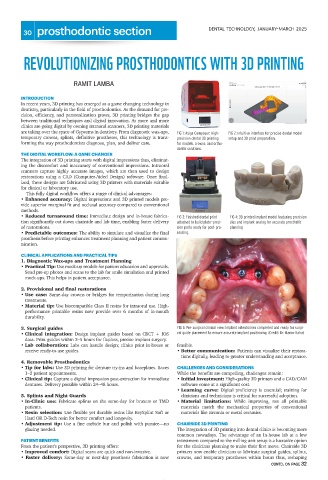
              are taking over the space of Gypsums in dentistry. From diagnostic wax-ups,  FIG 1: Asiga Composer: High-  FIG 2: Intuitive interface for precise dental model
              temporary crowns, splints, definitive prostheses, this technology is trans-  precision dental 3D printing  setup and 3D print preparation.
              forming the way prosthodontists diagnose, plan, and deliver care.  for models, crowns, and ortho-
                                                                                dontic solutions.
              THE DIGITAL WORKFLOW: A GAME CHANGER
              The integration of 3D printing starts with digital impressions thus, eliminat-
              ing the discomfort and inaccuracy of conventional impressions. Intraoral
              scanners  capture  highly  accurate  images,  which  are  then  used  to  design
              restorations using a CAD (Computer-Aided Design) software. Once final-
              ized, these designs are fabricated using 3D printers with materials suitable
              for clinical or laboratory use.
                This fully digital workflow offers a range of clinical advantages:
              • Enhanced accuracy: Digital impressions and 3D printed models pro-
              vide superior marginal fit and occlusal accuracy compared to conventional
              methods.
              • Reduced turnaround time: Immediate design and in-house fabrica-  FIG 3: Finished dental print  FIG 4: 3D printed implant model featuring precision
              tion significantly cut down chairside and lab time, enabling faster delivery  attached to build plate—preci-  dies and implant analog for accurate prosthetic
              of restorations.                                                  sion parts ready for post-pro-  planning
              • Predictable outcomes: The ability to simulate and visualize the final  cessing.
              prosthesis before printing enhances treatment planning and patient commu-
              nication.

              CLINICAL APPLICATIONS AND PRACTICAL TIPS
              1. Diagnostic Wax-ups and Treatment Planning
              • Practical Tip: Use mock-up models for patient education and approvals.
               Send pre-op photos and scans to the lab for smile simulation and printed
               mock-ups. This helps in patient acceptance.

              2. Provisional and final restorations
              • Use case: Same-day crowns or bridges for temporization during long
               treatments.
              • Material tip: Use biocompatible Class II resins for intraoral use. High-
               performance  printable  resins  now  provide  over  6  months  of  in-mouth
               durability.


              3. Surgical guides                                                FIG 5: Pre-surgical clinical view: Implant osteotomies completed and ready for surgi-
              • Clinical  integration: Design  implant  guides  based  on  CBCT  +  IOS  cal guide placement to ensure accurate implant positioning. (Credit: Dr. Manav Kalra)
               data. Print guides within 3–5 hours for flapless, precise implant surgery.
              • Lab collaboration: Labs can handle design; clinics print in-house or  feasible.
               receive ready-to-use guides.                                     • Better communication: Patients can visualize their restora-
                                                                                  tions digitally, leading to greater understanding and acceptance.
              4. Removable Prosthodontics
              • Tip for labs: Use 3D printing for denture try-ins and baseplates. Saves  CHALLENGES AND CONSIDERATIONS
               1–2 patient appointments.                                        While the benefits are compelling, challenges remain:
              • Clinical tip: Capture a digital impression post-extraction for immediate  • Initial investment: High-quality 3D printers and a CAD/CAM
               dentures. Delivery possible within 24–48 hours.                    software come at a significant cost.
                                                                                • Learning curve: Digital proficiency is essential; training for
              5. Splints and Night Guards                                         clinicians and technicians is critical for successful adoption.
              • In-Clinic  use: Fabricate splints on the same-day for bruxers or TMD  • Material  limitations: While  improving,  not  all  printable
               patients.                                                          materials  match  the  mechanical  properties  of  conventional
              • Resin selection: Use flexible yet durable resins like KeySplint Soft or  materials like zirconia or metal ceramics.
               Hard OR D-Tech resin for better comfort and longevity.
              • Adjustment tip: Use a fine carbide bur and polish with pumice—no  CHAIRSIDE 3D PRINTING
               glazing needed.                                                  The integration of 3D printing into dental clinics is becoming more
                                                                                common nowadays. The advantage of an In-house lab at a low
              PATIENT BENEFITS                                                  investment compared to the milling unit setup is a lucrative option
              From the patient’s perspective, 3D printing offers:               for the clinicians planning to make their first move. Chairside 3D
              • Improved comfort: Digital scans are quick and non-invasive.     printers now enable clinicians to fabricate surgical guides, splints,
              • Faster  delivery: Same-day or next-day prosthesis fabrication is now   crowns, and temporary prostheses within hours thus, reshaping
                                                                                                                         CONTD. ON PAGE 32

