


Page 13 - DT Vol 15 No 3
P. 13
implantology I
             DENTAL TECHNOLOGY, JULY-SEPTEMBER 2025                                                                              13


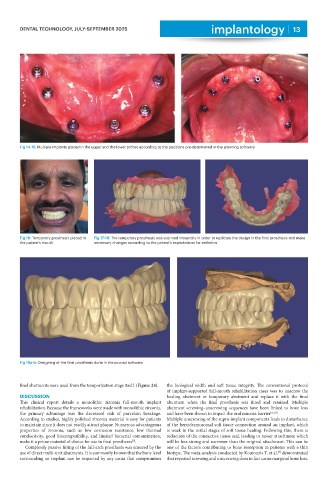
             Fig 14-15: Multiple implants placed in the upper and the lower arches according to the positions pre-determined in the planning software


             Fig 16: Temporary prosthesis placed in   Fig 17-18: The temporary prosthesis was scanned intraorally in order to replicate the design in the final prosthesis and make
             the patient’s mouth            necessary changes according to the patient’s expectations for esthetics


             Fig 19a-b: Designing of the final prosthesis done in the exocad software


             final abutments were used from the temporization stage itself. (Figure 24).  the  biological  width  and  soft  tissue  integrity.  The  conventional  protocol
                                                                           of implant-supported full-mouth rehabilitation cases was to unscrew the
             DISCUSSION                                                    healing abutment or temporary abutment and replace it with the final
             This clinical report details a monolithic zirconia full-mouth implant  abutment  when the  final prosthesis was fitted and retained.  Multiple
             rehabilitation. Because the frameworks were made with monolithic zirconia,  abutment screwing–unscrewing sequences have been linked to bone loss
             the primary advantage was the decreased risk of porcelain breakage.  and have been shown to impact the oral mucosa barrier [6,7,8] .
             According to studies, highly polished zirconia material is easy for patients  Multiple unscrewing of the supra-implant components leads to disturbance
             to maintain since it does not readily attract plaque. Numerous advantageous  of the hemidesmosomal soft tissue connection around an implant, which
             properties  of  zirconia,  such  as  low  corrosion  resistance,  low  thermal  is weak in the initial stages of soft tissue healing. Following this, there is
             conductivity, good biocompatibility, and limited bacterial contamination,  reduction of the connective tissue seal, leading to newer attachment which
                                                            [5]
             make it a prime material of choice for use in final prostheses .  will be less strong and narrower than the original attachment. This can be
               Completely passive fitting of the full-arch prosthesis was ensured by the  one of the factors contributing to bone resorption in patients with a thin
             use of direct multi-unit abutments. It is commonly known that the bone level  biotype. The meta-analysis conducted by Koutouzis T. et al.  demonstrated
                                                                                                                           [9]
             surrounding an implant can be impacted by any cause that compromises  that repeated screwing and unscrewing does in fact cause marginal bone loss.

