


Page 32 - DT Vol 15 No 3
P. 32
32   I implantology                                                        DENTAL TECHNOLOGY, JULY-SEPTEMBER 2025


                         DIGITALLY GUIDED IMMEDIATE FULL-ARCH


                 REHABILITATION WITH CUSTOMIZED 3D-PRINTED


                                SHELL TEMPLATES: A CASE REPORT


                                   ANAND KRISHNAMURTHY, RAHUL KAKODKAR, RONIL KAKODKAR


             INTRODUCTION
             Full-arch implant rehabilitation with immediate loading offers functional,
             psychological, and esthetic benefits to edentulous patients or to those with
             terminal dentition. Predictability of such treatments relies on accurate implant
             positioning, maintenance of vertical dimension, and a passive-fitting definitive
             prosthesis. The integration of digital workflows and additive manufacturing has
             enabled clinicians to streamline this process, enhancing precision and reducing
             the treatment time. This report details a workflow incorporating a 3D-printed shell
             used as a customized special tray to capture implant positions and verify occlusion
             simultaneously, ensuring  a verified master cast  for passive bar fabrication and
             timely delivery of the final zirconia restoration.

             CASE PRESENTATION
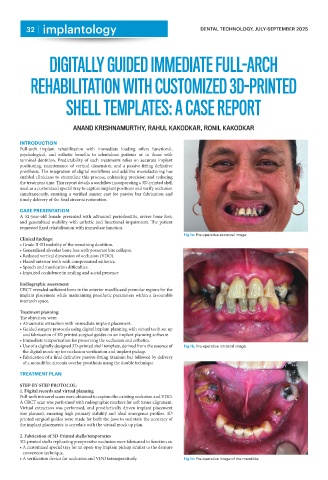
             A 52-year-old female presented with advanced periodontitis, severe bone loss,
             and generalized mobility with esthetic and functional impairment. The patient
             requested fixed rehabilitation with immediate function.
                                                                                   Fig 1a: Pre-operative extraoral image
             Clinical findings:
             • Grade II-III mobility of the remaining dentition.
             • Generalized alveolar bone loss with posterior bite collapse.
             • Reduced vertical dimension of occlusion (VDO).
             • Flared anterior teeth with compromised esthetics.
             • Speech and mastication difficulties.
             • Impaired confidence in smiling and social presence

             Radiographic assessment:
             CBCT revealed sufficient bone in the anterior maxilla and premolar regions for the
             implant placement while maintaining prosthetic parameters within a favourable
             interarch space.

             Treatment planning:
             The objectives were:
             • Atraumatic extraction with immediate implant placement.
             •  Guided surgery protocols using digital implant planning with virtual teeth set up
              and fabrication of 3D printed surgical guides on an implant planning software
             • Immediate temporization for preserving the occlusion and esthetics.
             •  Use of a digitally designed 3D-printed shell template, derived from the essence of   Fig 1b: Pre-operative intraoral image
              the digital mock-up for occlusion verification and implant pickup.
             •  Fabrication of a final definitive passive-fitting titanium bar followed by delivery
              of a monolithic zirconia overlay prosthesis using the double technique
             TREATMENT PLAN


             STEP-BY-STEP PROTOCOL:
             1. Digital records and virtual planning
             Full-arch intraoral scans were obtained to capture the existing occlusion and VDO.
             A CBCT scan was performed with radiographic markers for soft tissue alignment.
             Virtual extraction was performed, and prosthetically driven implant placement
             was planned, ensuring high primary stability and ideal emergence profiles. 3D
             printed surgical guides were made for both the jaws to maintain the accuracy of
             the implant placements to correlate with the virtual mock up plan.

             2. Fabrication of 3D-Printed shells/temporaries
             3D-printed shells replicating preoperative occlusion were fabricated to function as:
             •  A customized special tray for an open-tray implant pickup similar to the denture
              conversion technique.
             • A verification device for occlusion and VDO intraoperatively.       Fig 1c: Pre-operative image of the mandible

