


Page 28 - DT Vol 15 No 3
P. 28
28   I aesthetics                                                          DENTAL TECHNOLOGY, JULY-SEPTEMBER 2025


            CASE IV: RESTORATION OF MISALIGNED REAR ENDS


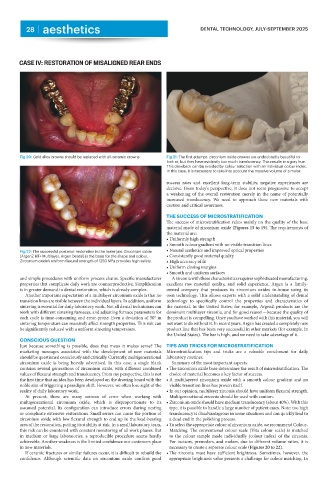
             Fig 20: Gold alloy crowns should be replaced with all-ceramic crowns  Fig 21: The first attempt: zirconium oxide crowns are undoubtedly beautiful to
                                                                           look at, but they have evidently too much translucency. This results in a gray hue.
                                                                           This drawback can be avoided by colour selection with an individual colour index.
                                                                           In this case, it is necessary to take into account the massive volume of a molar.

                                                                           success rates and excellent long-term stability, negative experiences are
                                                                           decisive. From today’s perspective, it does not seem progressive to accept
                                                                           a weakening of the overall restoration merely in the name of potentially
                                                                           increased translucency. We need to approach these new materials with
                                                                           caution and critical awareness.
                                                                           THE SUCCESS OF MICROSTRATIFICATION
                                                                           The success of microstratification relies mainly on the quality of the base
                                                                           material made of zirconium oxide (Figures 15 to 19). The requirements of
                                                                           the material are:
                                                                           • Uniformly high strength
                                                                           • Smooth colour gradient with no visible transition lines
             Fig 22: The successful posterior restoration in the lower jaw. Zirconium oxide   • Natural aesthetics and improved optical properties
             (ArgenZ HT+ Multilayer, Argen Dental) is the basis for the shape and colour.   • Consistently good material quality
             Zirconium oxide’s uniform flexural strength of 1250 MPa provides high safety.  • High accuracy of fit
                                                                           • Uniform closing margins
                                                                           • Smooth and uniform surfaces
             and simple procedures with uniform process chains. Specific manufacturer   A zirconia with these characteristics requires sophisticated manufacturing,
             properties that complicate daily work are counterproductive. Simplification  excellent raw material quality, and solid experience. Argen is a family-
             is in greater demand in dental restoration, which is already complex.  owned company that produces its zirconium oxides in-house using its
               Another important expectation of a multilayer zirconium oxide is that no  own technology. This allows experts with a solid understanding of dental
             transition lines are visible between the individual layers. In addition, uniform  technology to specifically control the properties and characteristics of
             sintering is essential for daily laboratory work. Not all dental technicians can  the material. In the United States, for example, ArgenZ products are the
             work with different sintering furnaces, and adjusting furnace parameters for  dominant multilayer zirconia, and for good reason—because the quality of
             each cycle is time-consuming and error-prone. Even a deviation of 50° in  the product is compelling. Once you have worked with this material, you will
             sintering temperature can massively affect strength properties. This risk can  not want to do without it. In recent years, Argen has created a completely new
             be significantly reduced with a uniform sintering temperature.  product line that has been very successful in other markets (for example, in
                                                                           the United States). The bar is high, and we need to take advantage of it.
             CONSCIOUS QUESTION
             Just  because  something  is  possible,  does  that  mean  it  makes  sense?  The  TIPS AND TRICKS FOR MICROSTRATIFICATION
             marketing messages associated with the development of new materials  Microstratification tips and tricks are a valuable enrichment for daily
             should be questioned consciously and critically. Currently, multigenerational  laboratory routines.
             zirconium oxide is being heavily advertised. In this case, a single blank   Summary of the most important aspects:
             contains several generations of zirconium oxide, with different combined  •  The zirconium oxide base determines the result of microstratification. The
             values of flexural strength and translucency. From my perspective, this is not   choice of material becomes a key factor of success.
             the first time that an idea has been developed on the drawing board with the  •  A multilayered zirconium oxide with a smooth colour gradient and no
             noble aim of triggering a paradigm shift. However, we often lose sight of the   visible transition lines has proven itself.
             reality of daily laboratory work.                             •  In our opinion, multilayer zirconia should have uniform flexural strength.
               At  present,  there  are  many  sources  of  error  when  working  with   Multigenerational zirconia should be used with caution.
             multigenerational  zirconium  oxide,  which  is  disproportionate  to  its  •  Zirconium oxide should have medium translucency (about 40%). With this
             assumed potential. Its configuration can introduce errors during nesting   type, it is possible to handle a large number of patient cases. Note: too high
             or complicate extensive restorations. Small errors can cause the portion of   translucency is disadvantageous in some situations and can quickly lead to
             zirconium oxide with low flexural strength to end up in the load-bearing   a dead end in the polishing process.
             area of the restoration, putting its stability at risk. In a small laboratory team,  •  To select the appropriate colour of zirconium oxide, we recommend Colour-
             this risk can be countered with constant monitoring of all work phases. But   Matching. The conventional colour scale (Vita colour scale) is matched
             in medium or large laboratories, a reproducible procedure seems hardly   to the colour sample made individually (colour index) of the zirconia.
             achievable. Another weakness is the limited confidence our customers place   For incisors, premolars, and molars, due to different volume ratios, it is
             in new materials.                                              necessary to create a separate colour scale (Figures 20 to 22).
               If ceramic fractures or similar failures occur, it is difficult to rebuild the  •  The zirconia must have sufficient brightness. Sometimes, however, the
             confidence. Although scientific data on zirconium oxide confirm good   appropriate brightness value presents a challenge for colour matching. In

